

Krampus is the horned, fur-clad shadow of St. Nicholas — a Christmas devil from Alpine folklore who prowls the night in the first days of December in search of the naughty. While the saint rewards well-behaved children, Krampus punishes the rest. We met him in South Tyrol. More than once. And yes, the bells are every bit as terrifying as the horns.
In the Alps of Austria, Bavaria and South Tyrol, the holiday season isn’t all pretty bows and ribbons. As we found out, it’s also fangs, horns, fire and fur. Lots and lots of fur. Here, the Christmas season still makes room for darkness.
Every December, towns and villages across the mountains and valleys unleash one of Europe’s wildest Christmas traditions: Krampus. Some encounters are little more than theatrical parades. Others place you frighteningly close to towering beasts swinging birch branches, rattling chains and charging through streets in masks that look capable of scaring the Devil himself.
We have attended several Krampus events in South Tyrol, and what began as curiosity quickly became one of our favorite reasons to visit the region during Advent. We were drawn to the dance between light and darkness, a tradition that embraces the whole range of human experience — even the parts that go “bump” in the Alpine night. Welcome to Christmas with teeth.
Who is Krampus?
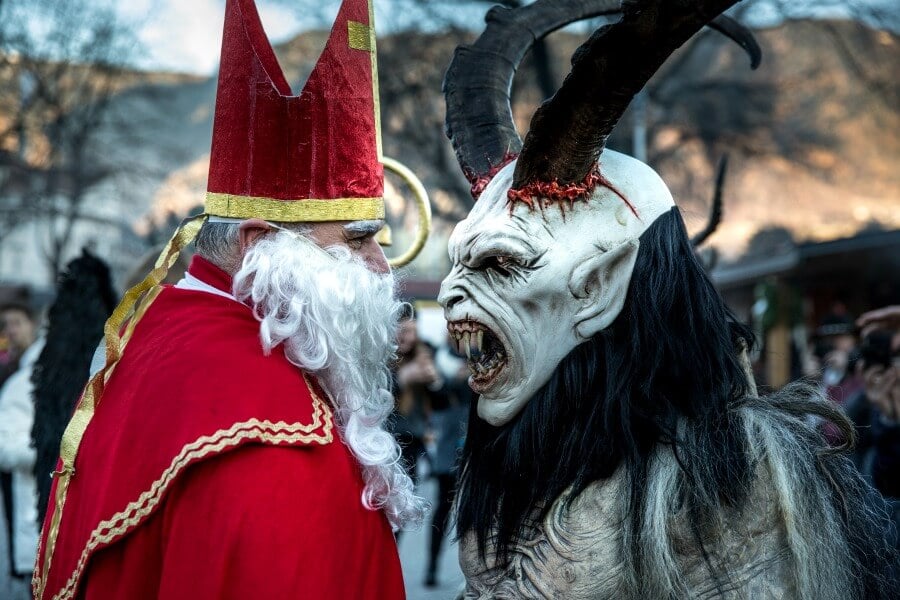
Krampus is the horned companion of St. Nicholas in Alpine folklore. He’s a devil-like figure with goat horns, shaggy fur, fangs, rattling chains and heavy cowbells who appears during the first days of December to punish badly behaved children while the saint rewards the good.
Or, put less academically: Krampus is what happens when Christmas stops pretending everybody deserves a present. His name is often traced to the Germanic krampen, meaning claw, though, like much about Krampus, the story gets murkier the farther back you go.
What isn’t murky is the job description. St. Nicholas takes care of the good kids. Nuts. Fruit. Sweets. Small gifts.
Krampus gets the rest.
Depending on which version of the tale you hear, badly behaved children might be chased through the streets, swatted with birch branches or shoved into a basket and hauled away into the darkness.
Participation-trophy parenting, this was not. This was more of a “f…k around and find out” school of child-rearing. The kind designed to keep little ones on their best behavior long before anyone started handing out gold stars for trying.
Today, Krampus is not some quaint relic wheeled out for tourists. Every December, he is still very much alive. Men, and some women, disappear behind enormous hand-carved wooden masks, pull on layers of fur, strap cowbells around their waists and turn otherwise charming Alpine villages into something that feels, for a few hours, much older and wilder.
We can tell you firsthand: when the bells start pounding and chains begin scraping across the cobblestones, Christmas in the Alps suddenly does not feel quite so cozy anymore.
RELATED READING
What it’s Like to Meet Krampus – Beware of the Din in the Dark
Whether they heard, saw, or sensed them first, we could not tell. But the children knew. They knew what darkness summons in December. When night falls fast and the cold cuts to the very marrow of your bones.
Indeed, the children knew well before the rest of us: something wicked this way comes.

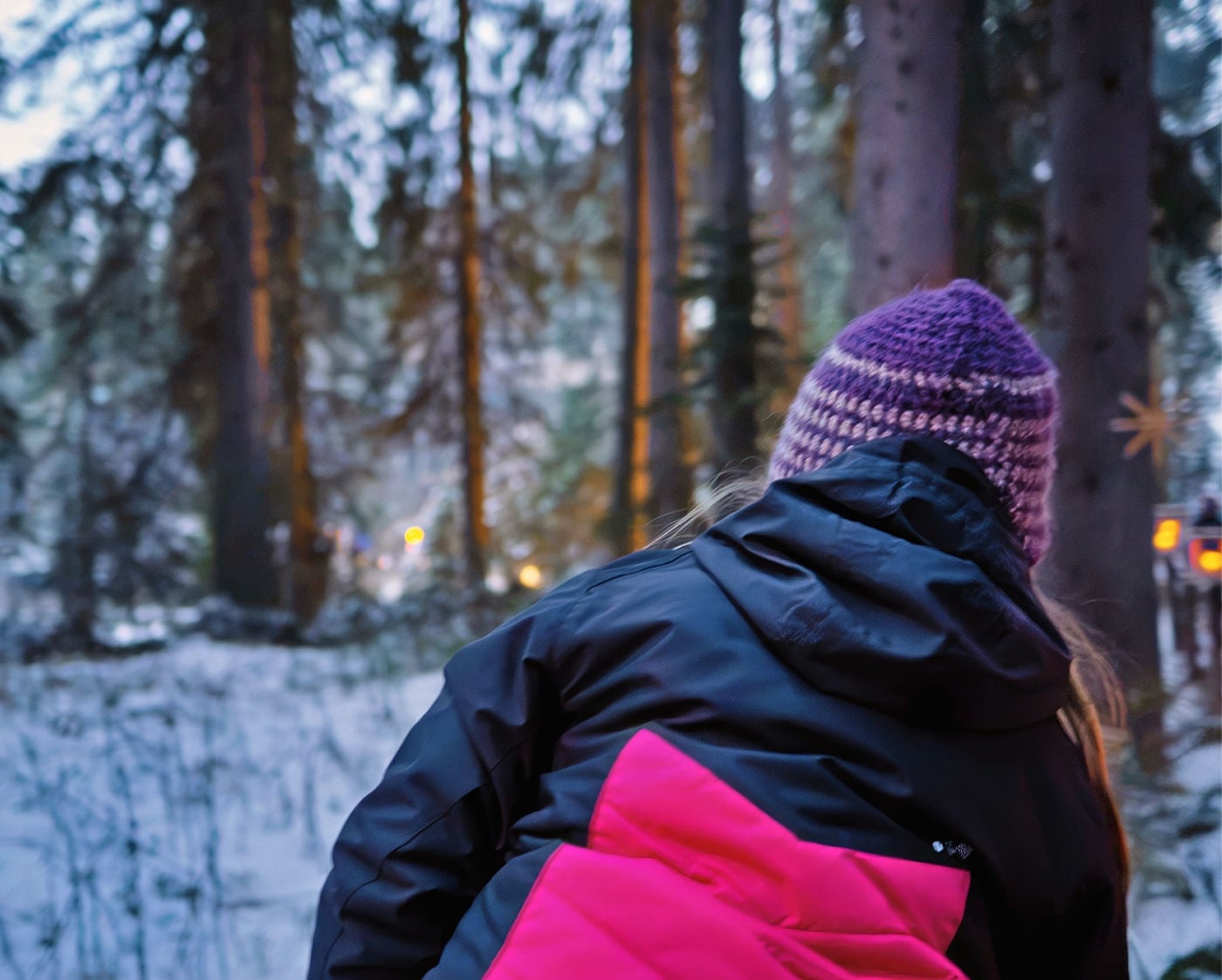
A faint clatter stirred somewhere beyond the lights. Three children standing near us gasped and scrambled onto the lower rail of a wooden fence, straining to see into the darkness between the trees. The bells grew louder. More children began looking around.
Then movement. At first only shadows. Then silhouettes.
And finally, horns. Enormous ones.
Remaining directly in their path suddenly seemed like an exceptionally poor life choice. We retreated to the fence. It did not help.
Within moments the creatures were upon us. Wolf-like fangs flashed beneath the lanterns. Long tongues spilled from grotesque faces. Chains rattled. Cowbells crashed against thick coats of fur. Then came the switches. Stings shot through our legs as bundles of sticks swept past.
Message received. Whatever minor indiscretions we had committed during the previous year were officially behind us.
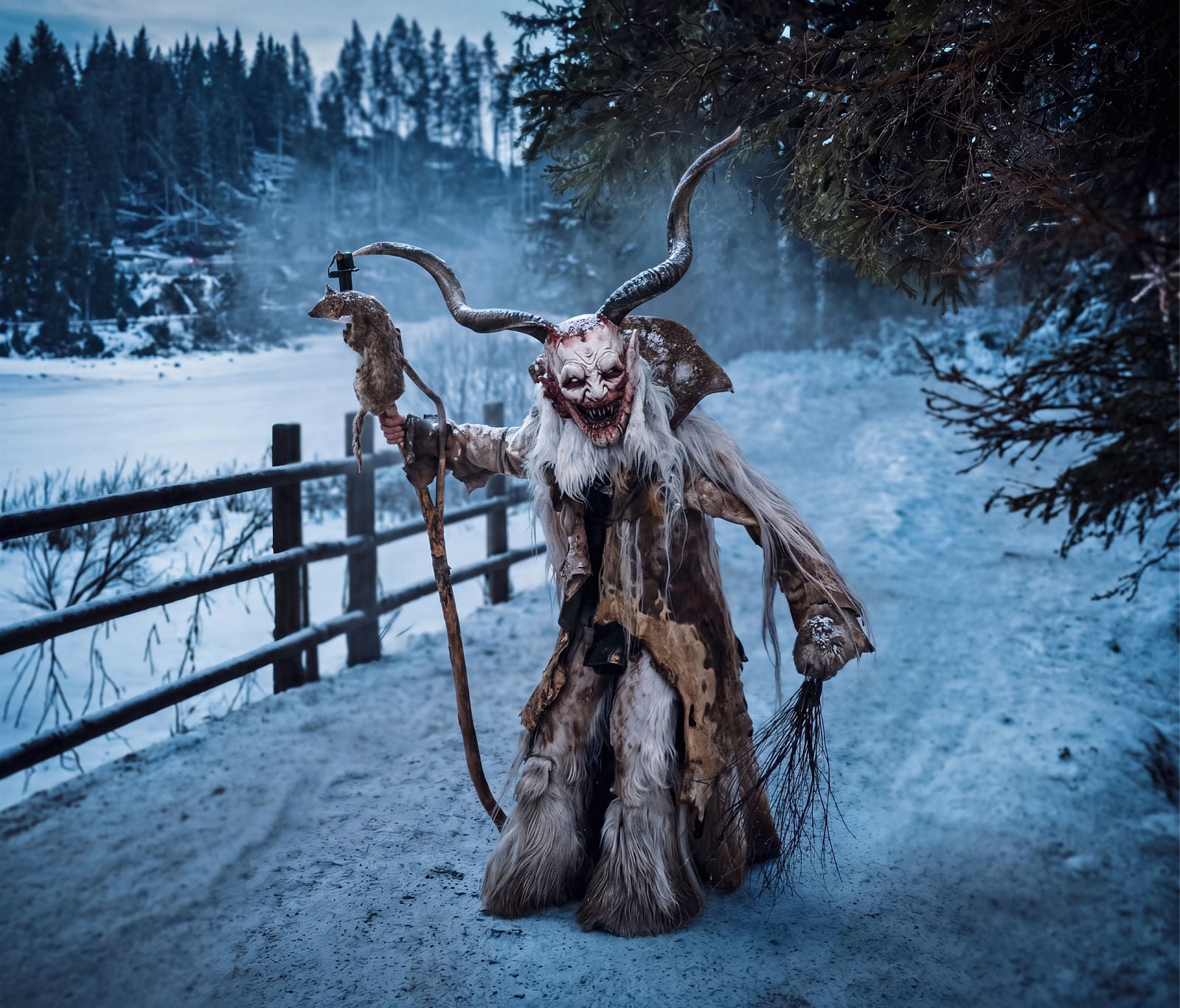
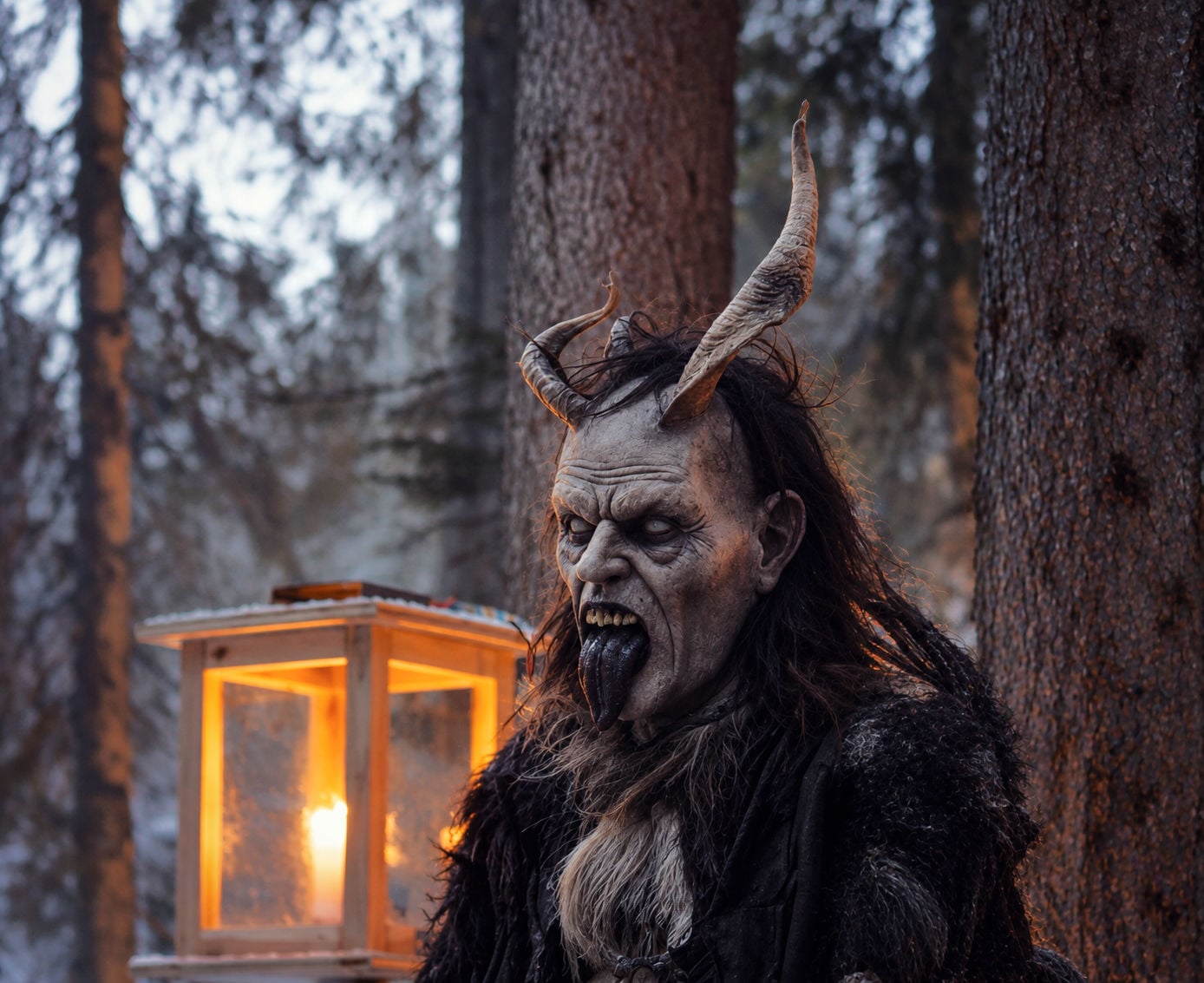
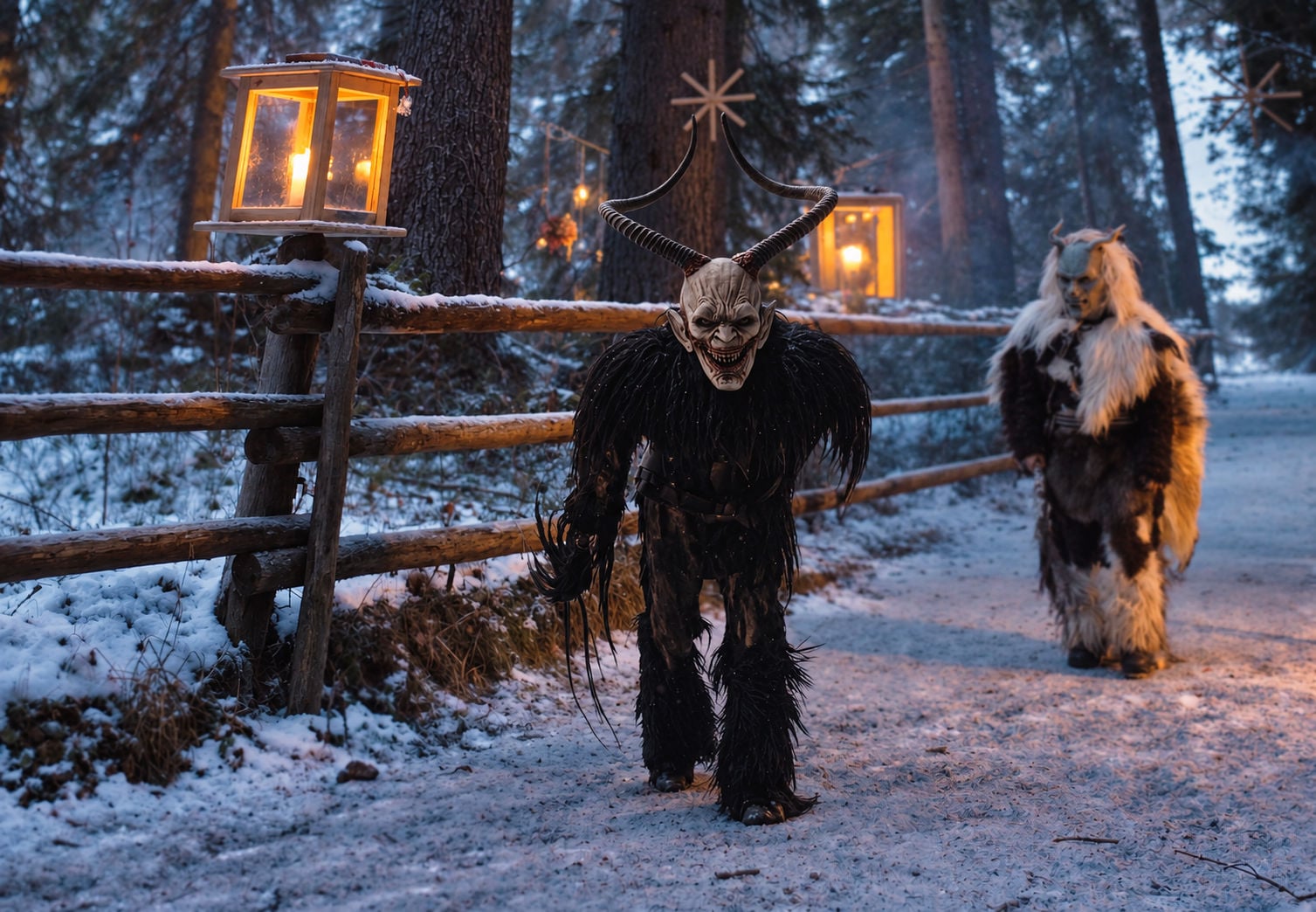
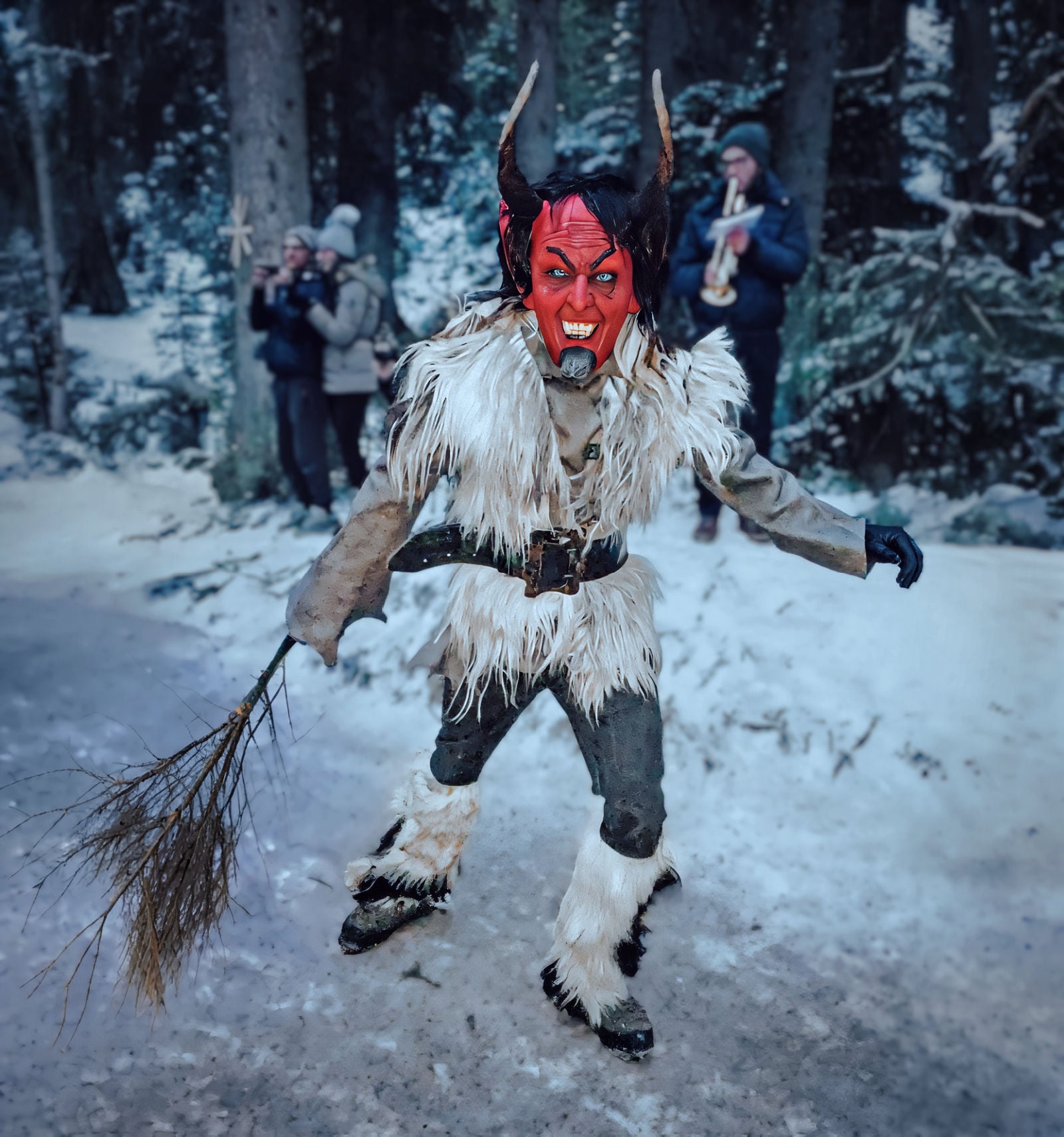
The sound is what we remember most. Heavy bells do not merely ring when a Krampus is running toward you. You feel them.
Our first encounter happened at a Christmas celebration at Lago di Carezza, tucked into an ancient spruce forest and framed by the jagged Latemar and Rosengarten massifs of the Dolomites. The Krampus we met there remain burned into memory. We recovered with generous pours of Glühwein, a spiced wine concoction tailor-made for restoring circulation and courage.
One reasonable encounter with the Christmas Devil should have been enough.
It wasn’t. A few nights later, we went looking for him on purpose. But before we get to that, a question worth answering: what exactly had just chased us down a mountainside in the dark?
RELATED READING
Where Did Krampus Come From? The Honest Answer
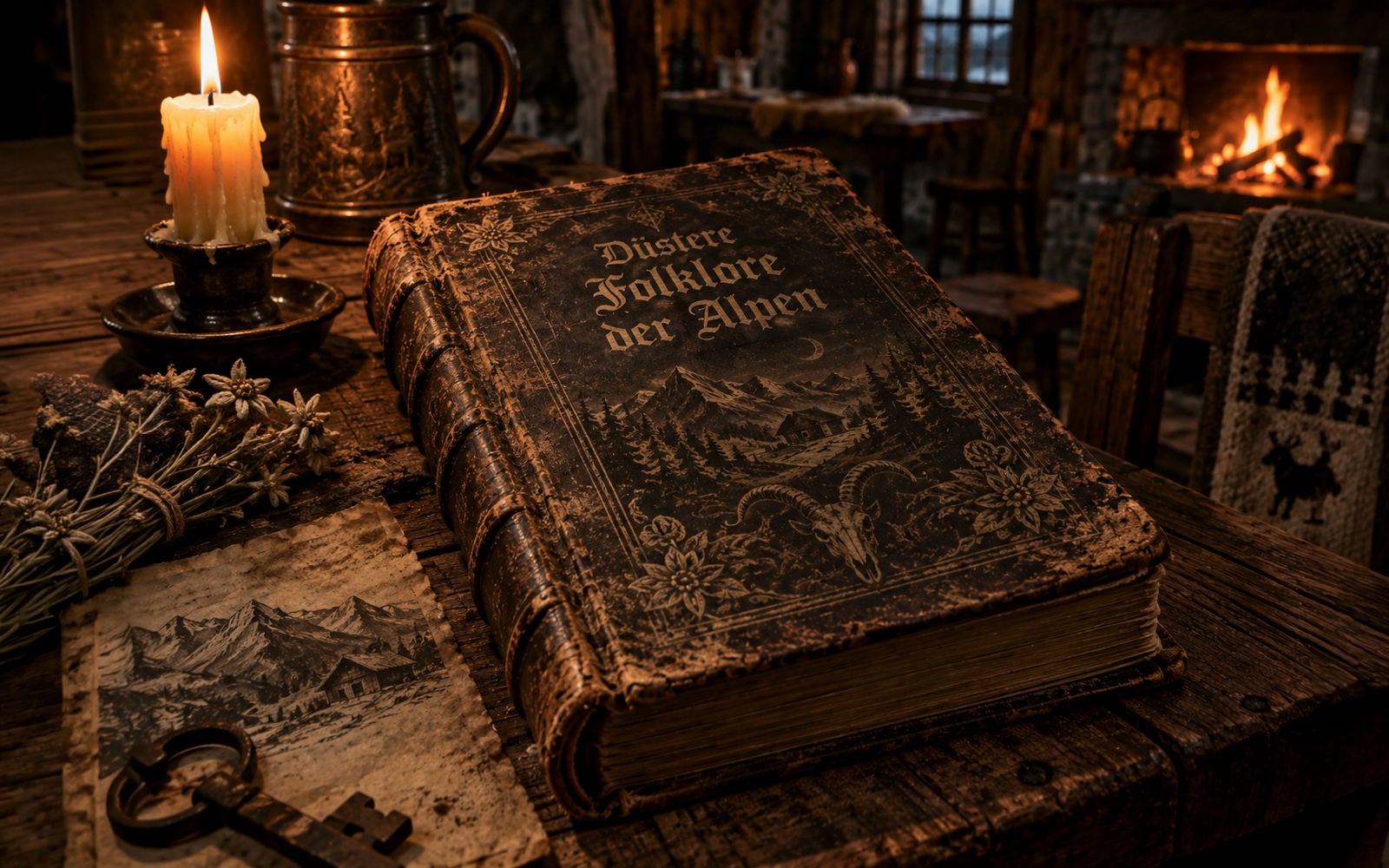
The origin of Krampus is genuinely mysterious. His widely reported pagan roots are not supported by the historical record, and the earliest solid trail points instead toward medieval devil imagery and early modern era St. Nicholas church plays in the Alps.
As we dug into the history ourselves, that did not surprise us. The past is rarely as tidy as the version the internet likes to repeat. What emerged was something far messier… and far more interesting: saints and devils sharing the stage, St. Nicholas traditions taking root across the Alpine world, and generations of maskers reshaping the beast from valley to valley. What you do not find is a clean trail leading back to some forgotten pre-Christian god.
The Backstory You May Have Heard
Search for Krampus origins and you will find a beautifully packaged story: he is an ancient pre-Christian Alpine spirit, some leftover from Germanic paganism, maybe even the son of the Norse goddess Hel, who somehow survived Christianization and ended up working crowd control for St. Nicholas.
It’s a hell of a story. But it also gets shakier the deeper you look.
We ran into the “son of Hel” claim everywhere while researching the history of Krampus. Follow it backward, though, and things get strange. There is no known basis for it in Norse mythology. Instead, the idea appears to have slipped into modern Krampus lore through fantasy fiction, most notably Gerald Brom’s 2012 novel Krampus: The Yule Lord, in which the beast introduces himself as “son of Hel, bloodline of the great Loki.” From then on, it was repeated by mainstream media — echoing across the internet until fiction started wearing the clothes of fact.
The broader pagan explanation one often hears goes back further, but it does not necessarily rest on firmer ground. In the late 19th and early 20th centuries, folklorists began linking Alpine masking traditions to ancient Germanic religion. In 1958, Maurice Bruce pushed the idea several steps further in The Krampus in Styria, a short paper published in the journal Folklore. Without offering much in the way of evidence, he identified Krampus with the “Horned God of the Witches” and linked the birch switch to pagan initiation rites.
These were bold claims… sitting on thin evidence. Nearly seventy years later, they are still being repeated as settled fact.
What the Evidence Actually Supports
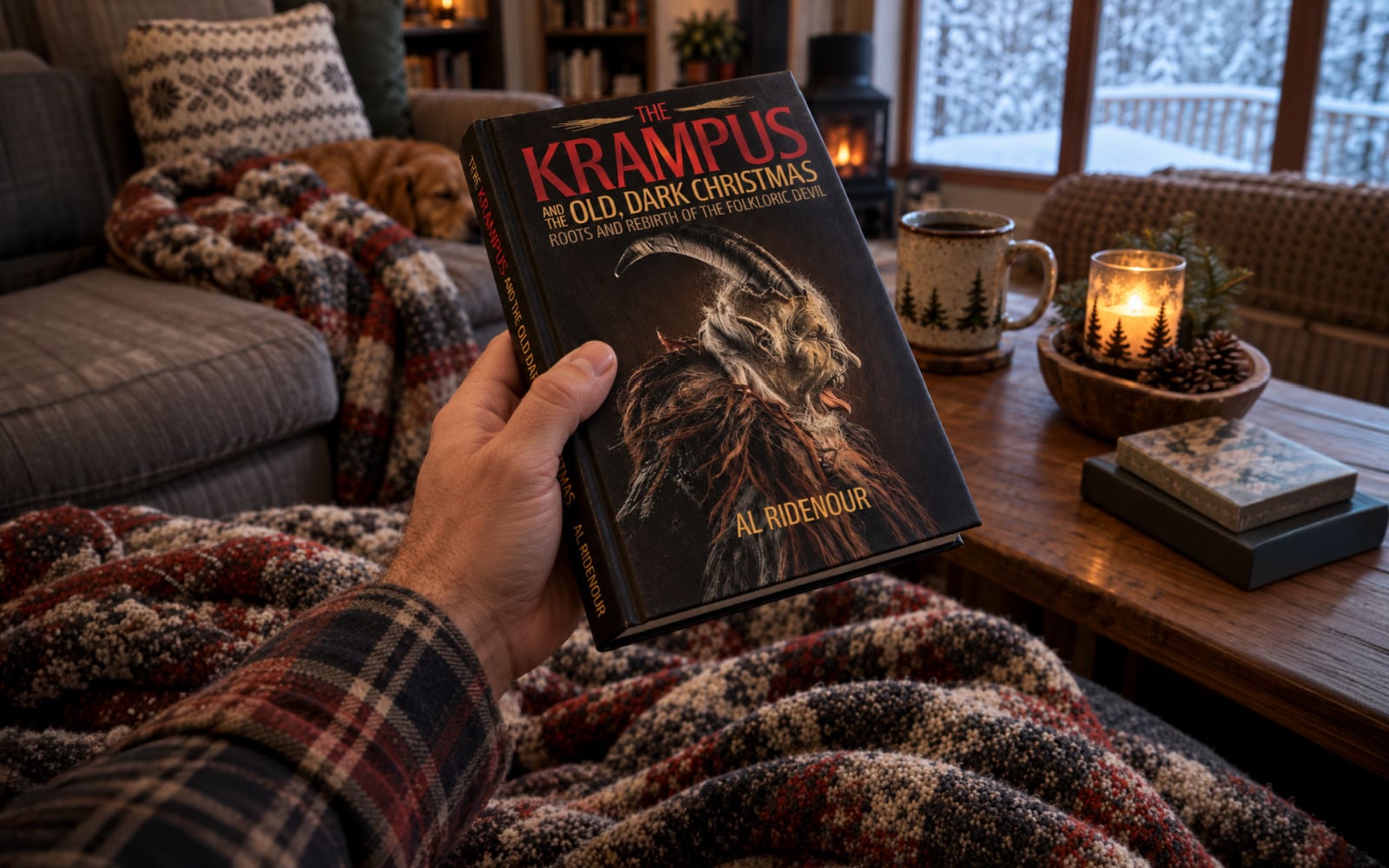
One of the best modern investigations into the tradition comes from folklorist Al Ridenour in The Krampus and the Old, Dark Christmas: Roots and Rebirth of the Folkloric Devil. When you follow the trail he lays out, Krampus begins to look less like some ancient pagan survivor and more like a creature assembled over centuries.
A piece of that puzzle is the Nikolausspiele, old St. Nicholas morality plays in which the saint was accompanied by a masked devil who threatened sinners and terrified badly behaved children. These plays still survive in rare pockets of the Alps. One of the most remarkable is the Reither Nikolausspiel in Reith im Alpbachtal, documented as far back as 1690, and performed only every seven years. We were especially intrigued to learn about it after recently staying just down the valley at Der Böglerhof in Alpbach.
But the Alps had their own winter traditions, too. For centuries, communities across Tyrol and Salzburg donned frightening masks, animal skins and other disguises during the darkest weeks of winter. Among them were the “Perchten”, strange and sometimes horrific masked figures associated with the winter season.
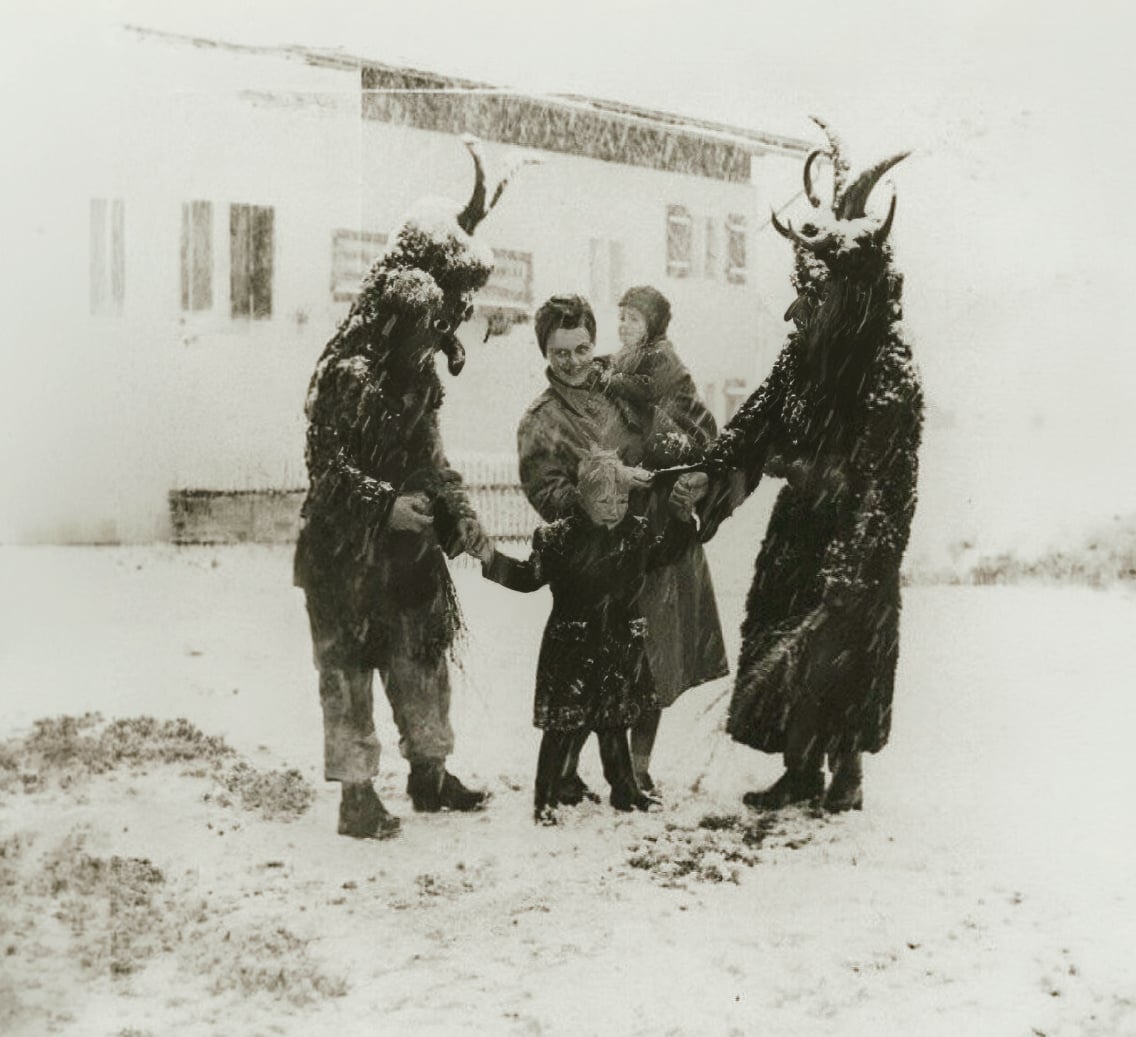
Over time, these traditions appear to have rubbed against one another. And out of that long, messy mixing of religion, folklore and village tradition, something increasingly recognizable as Krampus began to emerge.
Then there is the question of what Krampus was actually supposed to look like. Before postcards, photographs and mass media gave everyone the same picture, there was no official Krampus. No rulebook. No standard mask. No agreed-upon number of horns.
Alpine valleys were isolated, traditions were very localized, meaning the appearance of the beast changed from one village to the next. Rather than a uniform character, Krampus was more of a shape-shifting bogeyman passed along by word of mouth and fueled by the wild imaginations of children.
The Postcards That Invented the Krampus We Know
By the late 19th century, Krampus had a problem: nobody could quite agree on what he looked like. Then came the postcards.
Between roughly 1890 and World War I, “Krampuskarten” began circulating across Austria and the German-speaking world, many stamped with the wonderfully cheerful greeting “Gruß vom Krampus” — Greetings from Krampus.
For the first time, the beast had mass media. And many of the artists drawing him were far removed from the Alpine villages where the tradition actually lived. With little in the way of reference material, they borrowed from what they knew: the Christian Devil, theatrical demons and the goat-legged figure of Pan.

Slowly, a familiar creature took shape. Horns. Hooves. Fur. Fangs. And a tongue only a mother could love.
The cards themselves were all over the map. Some were genuinely frightening, with Krampus chasing children, swatting them with birch branches or stuffing them into baskets. Others were comic. And more than a few were surprisingly risqué, showing Krampus entangled with adult women in scenes Hallmark would probably decline to stock.
Then authorities decided the Christmas Devil could use some taming. Incredibly, Krampus was discouraged and restricted in Austrofascist Austria during the 1930s, and a 1934 New York Times headline noted that he had fallen out of official favor. It did not stick.
The tradition survived, and by the late 20th century Krampus had come roaring back, this time with organized clubs, larger events and the kind of Krampus Runs that now draw crowds across the world.
Want to see more historic Krampus imagery?
Krampus: The Devil of Christmas: Pre-WWI Krampus Postcard Reproductions showcases vintage Krampuskarten from the era when these strange and often darkly humorous images helped spread Krampus beyond the Alps.
Krampus Was Never the Only One
One detail we uncovered genuinely surprised us: Krampus was hardly the only frightening figure standing next to St. Nicholas on those frosty December nights.
Germany had “Knecht Ruprecht”. France “Père Fouettard”. Switzerland “Schmutzli”. Slovenia “Parkelj”. Different names, different costumes, same basic arrangement: a saint handing out sweets and something far less pleasant standing nearby with a switch.
That wider pattern makes the idea of Krampus originating from a specific pagan deity harder to square with the evidence. A Christian tradition spreading across Europe and being reshaped by local fears, customs and winter rituals makes far more sense.
Krampus simply won the marketing competition. We suspect the horns probably helped.
Krampus vs. Perchten: Not the Same Thing
A question we are often asked when planning Christmas trips to South Tyrol: are Krampus and Perchten the same thing? No. They look nearly identical and they are constantly mistaken for one another, but they belong to two different traditions.
The figures above all had one thing in common: they belonged to the world of St. Nicholas. Perchten did not. Rather than serving as the saint’s dark enforcers, they belonged to a different cycle of Alpine winter folklore associated especially with the Rauhnächte, the mysterious nights between Christmas and Epiphany.
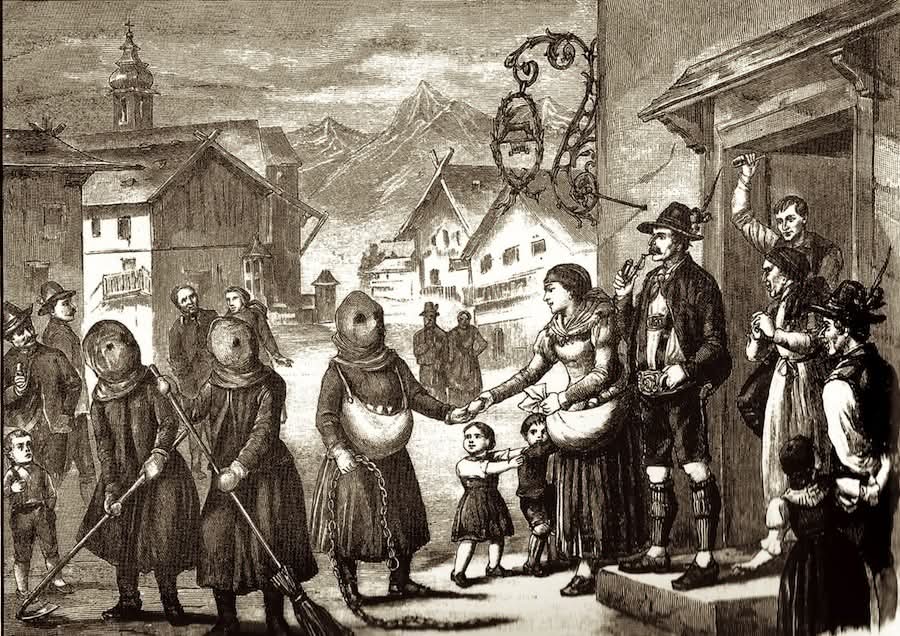
That does not mean their folklore was any gentler. Frau Perchta, or Perchta the Disemboweler, the female figure at the heart of the Perchten tradition, had a fearsome disciplinary streak of her own. In some tales, she punished lazy people and badly behaved children by slitting open their bellies and filling them with straw or stones. The difference is that Perchta answered to no saint. Her tradition belonged to the broader world of midwinter spirits, household order and the dangerous nights of the Rauhnächte, while the Perchten associated with her were often understood as helping drive away winter, evil spirits or other threatening forces.
Side by side, though, you would struggle to tell them apart. Fur. Horns. Carved masks. Enormous bells. The difference is the calendar and the job description, not the costume. That said, modern events blur the line constantly, mixing performers and terminology.
By the way, in South Tyrol you may hear “Tuifl”, the local dialect word for “devil.” Cross into Austria and the names shift valley by valley — “Klaubauf” in East Tyrol, “Bartl” in Carinthia and Styria, “Kramperl” around Salzburg and the Bavarian foothills.
So if something horned comes sprinting toward you in December, you probably will not have time for careful classification. But technically, no, they are not the same thing.
What Does the Name “Krampus” Mean?
Claw is the usual answer, and it may well be right. Like mountain weather, it is also not settled. Some etymologists have linked the name to old words for hooks, claws and things bent or crooked. Others are not convinced, and the more cautious dictionaries stop short of declaring any one answer definitive.
So treat “claw” as useful shorthand rather than gospel. A fitting outcome for a beast whose entire past is as clear as mud.
Face to Fangs in Margreid
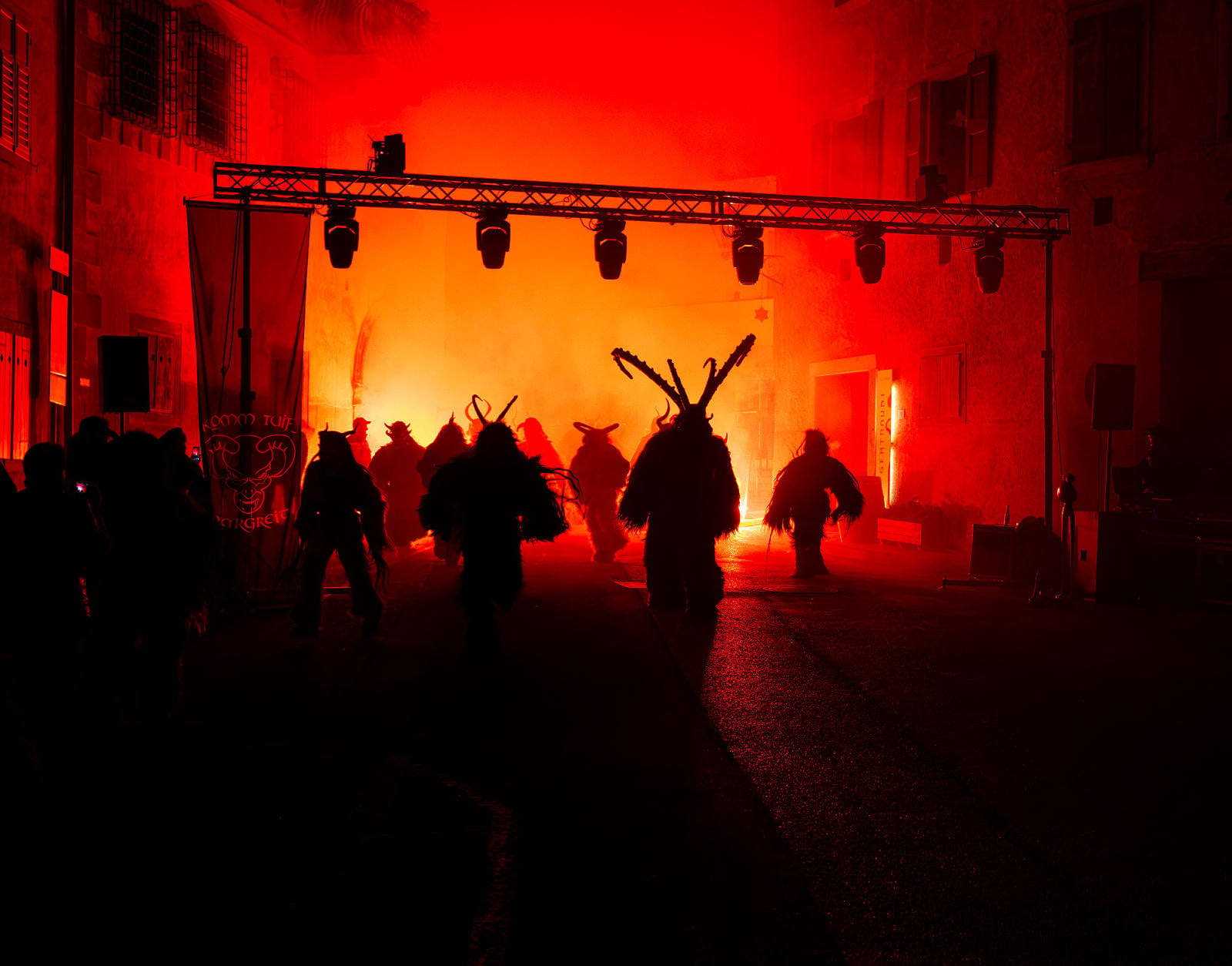
A few nights later we ventured to Margreid (Magrè), a storied wine village in South Tyrol’s Unterland, for one of the region’s oldest Krampus celebrations. This time, there would be no dark forest to blame for our uneasiness.
We stood shoulder to shoulder with villagers beneath old façades, staring down a damp cobblestone street disappearing into the night. Like before, the children stared wide-eyed ahead. But the black of the night only stared back. Then it began.
Fire belched into the sky and lights red as blood painted a billowing mist moving toward us. A tribal beat thundered in the air. The crowd began moving backward. We stood frozen.
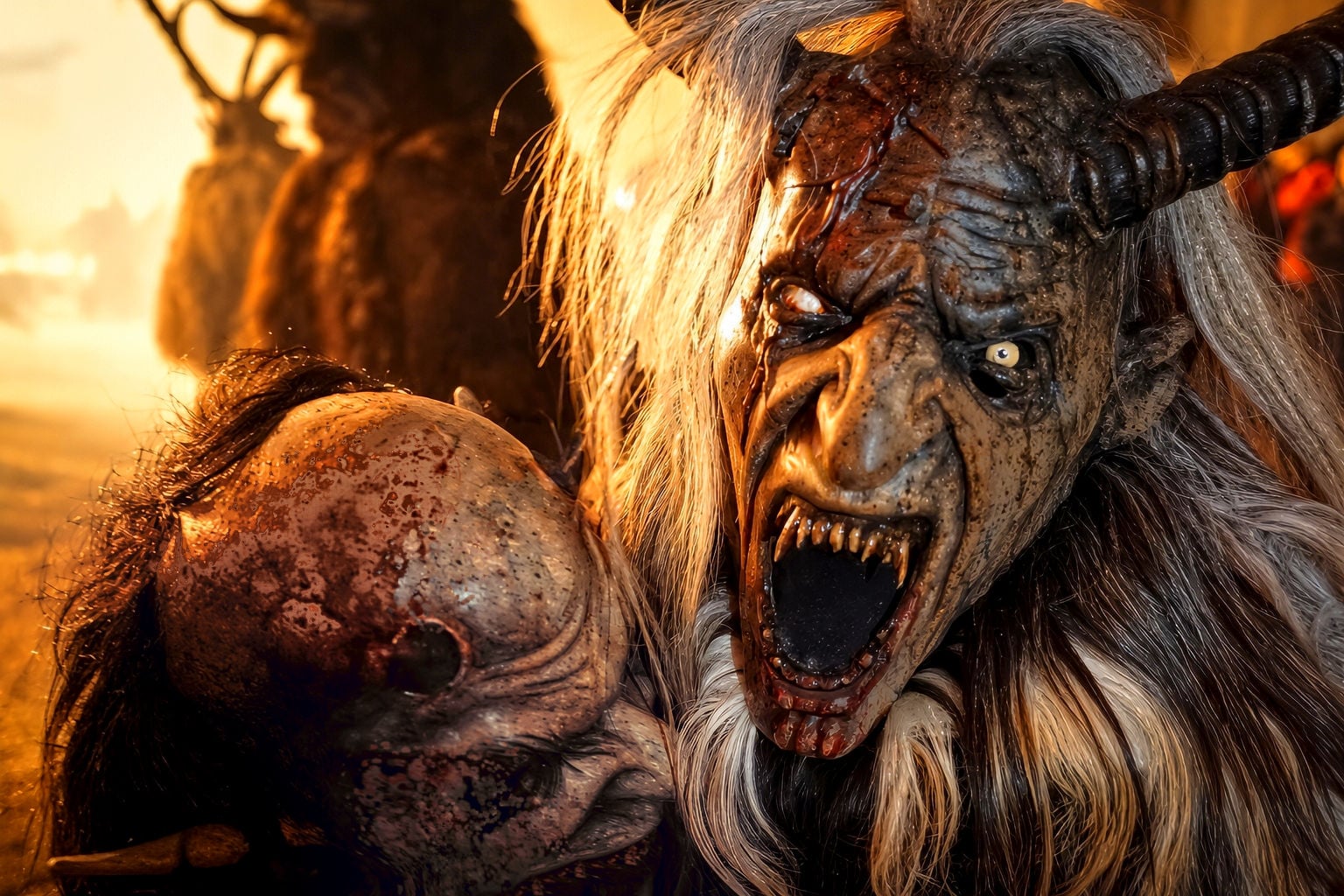
Materializing through the smoke was perhaps the most terrifying Krampus we have ever seen. Four immense horns rose like a crown above a hulking mass of tangled fur not even a grizzly bear would dare groom. It seemed less like a man in a costume than something the mountains had coughed up after several centuries underground.
We scattered. So did everyone else.
Then came another. And another. Soon the entire street had descended into chaos.


Krampus charged through the crowd swinging switches while massive bells slammed against their bodies. One hunted down a young man nearby and sent him dancing sideways as he desperately tried to avoid another swat.
Another lunged toward a little girl. She immediately burst into tears. We suspect she behaved exceptionally well for the remainder of December.
This is where photographs fail to capture what encountering Krampus actually feels like. The masks are extraordinary. The fire is dramatic. But it is the sound that gives the experience its primal edge: bells, chains, drums, shouting and screaming ricocheting between the walls of an old Alpine village.
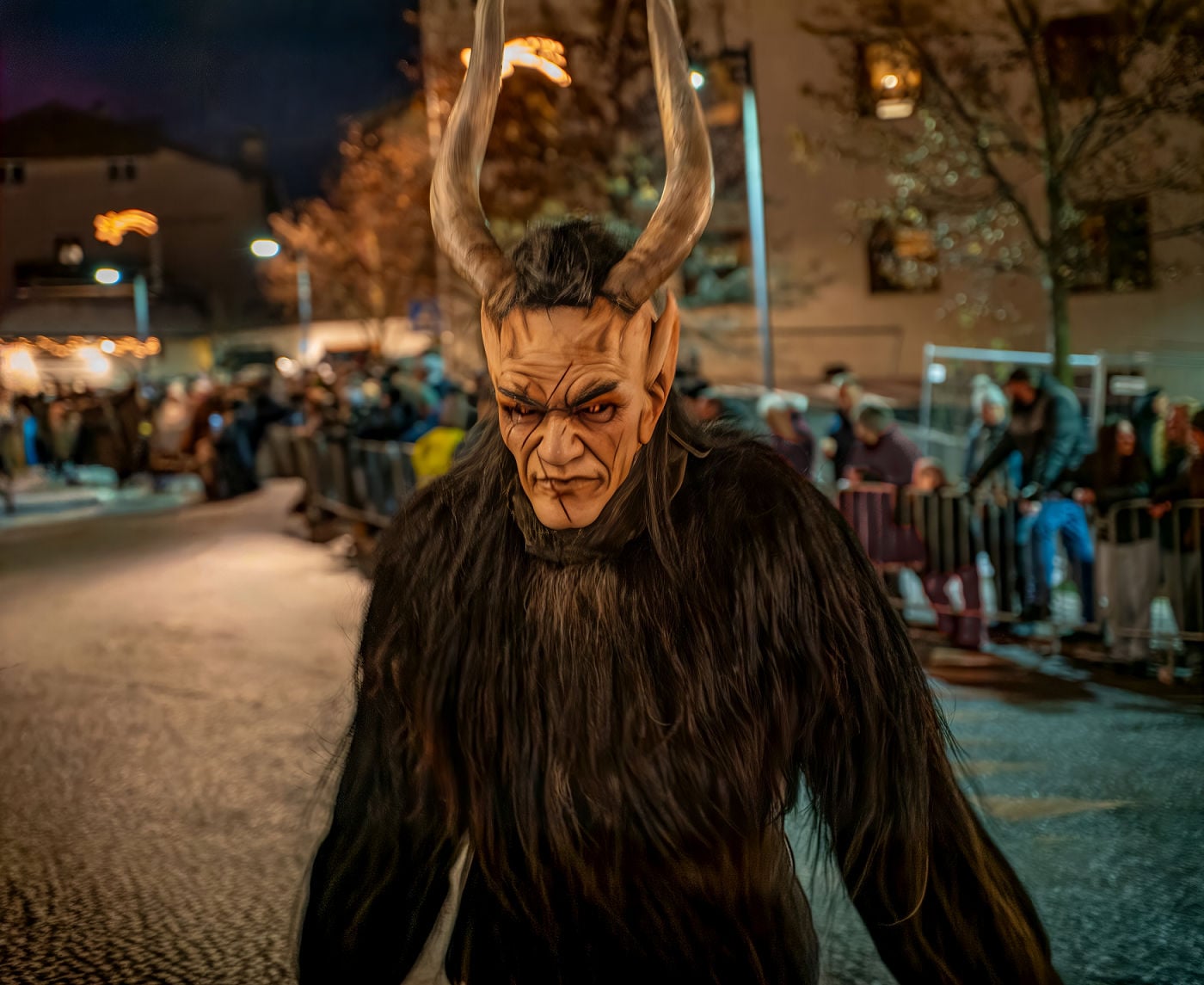


Then, roughly an hour later, it stopped. The fire died. The bells fell silent. And something peculiar happened.
Instead of stomping back to their caverns in the mountains, which we like to imagine lie somewhere amid the demonic-looking spires of Cadini di Misurina, the monsters became men again. Masks came off. Krampus posed for pictures. Kids who had spent the previous hour fleeing cautiously approached the same creatures that had terrified them.
Naturally, we did too. The chance to win over a Christmas Devil with a smile was not something we were about to miss.
RELATED READING
Want to Experience Krampus? Krampuslauf Events in the Dolomites →
How Authentic Krampus Masks Are Made

Once you stand face-to-face with a Krampus, one thing becomes impossible to miss: the masks are works of art. The most traditional examples are not mass-produced Halloween props. They are hand-carved wooden sculptures, and in South Tyrol the craft is taken seriously. South Tyrol’s official tourism authority describes hand-carved wooden masks as the most widespread style worn by the region’s Krampus, with the woodcarvers of the Tauferer Ahrntal especially renowned for the work.
The mask makers’ expert attention to detail creates realistic expressions that could frighten the Devil himself. Often carved from stone pine, though lime and maple see plenty of use as well, the process is an intricate dance between custom and precision. With rough cuts and deft carving knives, the woodblock begins its transformation. Slowly, a visage of Krampus emerges, complete with the sinister snarl that sends chills down spines
As the carving takes shape, it’s meticulously refined. Every curve, every furrow, needs the right touch of menace. However, mask-making isn’t all about aesthetics; it’s also about balance. A mask too heavy loses its nimbleness, too thin, and the essence is lost. The carver must achieve a harmonious meeting of wood and spirit.
In the final touches, demonic glass eyes and horns are added to the mask. The horns are often the real deal. Coming from goats or rams in the region. Ultimately, the mask is primed and painted with oil and acrylic strokes, transforming the wood into a living, breathing beast. A soft inner padding is then often added providing a layer of comfort for the would-be mask wearer.

The finished mask is then fitted to its owner and lined inside. And these are not light costume pieces. Wood-carved Krampus masks commonly weigh roughly 5.5–11 pounds (2.5–5 kg), and some run heavier still.
Imagine running through a village in one of those while wrapped in animal fur and carrying several enormous bells around your waist. Suddenly, merely standing in the crowd with a mug of Glühwein feels like the easier role.
Where to Find Authentic Krampus Masks
Ideally, you would purchase an authentic Krampus mask by visiting a woodcarvers shop in the Alps. However, with a little searching, you can find an authentic masks on sites such as Etsy that specialize in handmade and unique products hard to find elsewhere. Etsy also offers a number of other masks made from latex that are really well done and much more affordable than a wood-carved mask.
Where to See Krampus in South Tyrol
Krampus may be rooted in folklore, but he is hardly confined to storybooks. Each Advent, towns and villages across South Tyrol and the Dolomites stage Krampus runs, where groups of horned beasts thunder through the streets amid cowbells, fire and a great deal of nervous laughter. Around December 5, the traditional St. Nicholas and Krampus pairing still appears in villages across the region.
We’ve attended runs throughout South Tyrol, from intimate village celebrations to enormous spectacles involving hundreds of Krampus.
SEE OUR COMPLETE KRAMPUS RUN GUIDE
Book Your Private Christmas Market Tour

Make Brixen’s Christmas market the festive finale of a private day with Franz Lageder, a certified South Tyrolean Gourmet Ambassador. Begin with artisan cheese tastings at Capriz, then savor alpine wines at Köfererhof, an estate with more than a thousand years of history. Finish among the wooden stalls beneath Brixen’s cathedral towers, with mulled wine, Christmas cookies and time to browse. Franz handles pickup and the drive home, so you can enjoy every stop.
Explore the Christmas Experience*The St. Nicholas and Krampus photo is courtesy of Manrico Finotto.

I first heard about Krampus during a Europe Christmas market visit but wasn’t there on the right day and I’ve been curious ever since. I don’t like the whole scaring the crap of children on purpose part, but, still, I want to have both of your experiences! The woods and city square both sounded incredible. Great tip about the dark clothes
OMG Krampus freaks me out. This whole post does, actually…
That looks like so much fun! At first I thought this was a film review, lol! I need to attend one of these!
Omg now this would be one unique experience!!!! Love the detail of the Krampus masks. Very well done and definitely scary!
Oh my gosh – this looks so scary! We love watching Krampus, but not sure how I would feel about seeing it in real life. Ha ha!
Wow this is such an interesting take on Christmas. I don’t think I’d be going to visit Krampus during this jolly season,
Oh my goodness, they look so scary, my kids would be terrified. Looks fun for adults though
OMG that would freak me out! But the costumes and make up are very very well done.
I would love to take my kids to this! I’m not sure they would enjoy it as much as me though.
EEK! I don’t know, I got a little spooked (That was the point, right???) Fun tradition!
Oh my goodness this is way too scary for me (but I am definitely not the toughest person around haha). Easy to see how this would be so fun if you love the horror genre 🙂
as much as Americans love the horror genre, I don’t know why we aren’t celebrating krampus more. it’s so fun!
Totally agree Jasmine! It is such a blast!
Wow! I have never heard or seen anything like this, so I really enjoyed reading about it. Great photos, too!
OMG!! This looks seriously scary and I would be so so scared if I was there but it looks like it was such a fun thing to go to if you are into all things Krampus
You sure know how to use your words well to make a great story. I was pulled in and felt like I was right there with you. Too funny. I really love this.
Thank you Stephanie. Thrilled you loved our tale of evenings with the Krampus!
this is freakingly creepy. amazing. but dont expect me to go to the woods haha. very artisitic
Good Lord, I’m terrified by this post! We spend many winters in the Dolomiti in northern Italy, but have yet to see Krampus! I think this post is enough lol!
Ha! Well we hope you do not run into any then on your next visit to the Dolomites. Thanks for the comment Lisa!
O.M.G. I would *love* to have been able to torture my kids with that when they were little 🤣
Ha! No doubt! Krampus is a tradition that should be celebrated all over. Just imagine how much better behaved kids would be today!