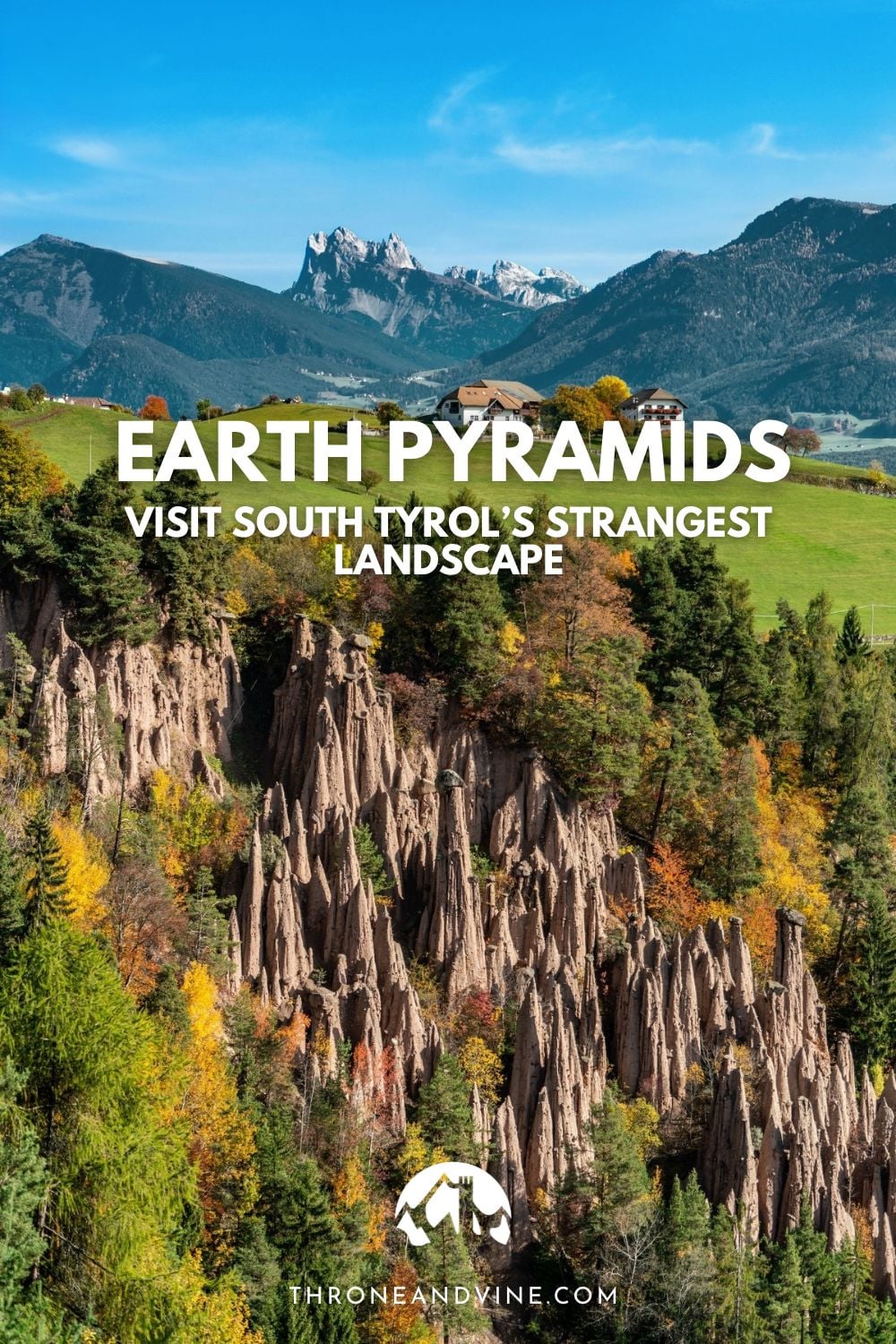
Rising from a ravine on the Renon plateau above Bolzano, the Earth Pyramids look like the remains of some ancient civilization with sketchy engineering standards. We show you how to visit South Tyrol’s strangest landscape, why those enormous boulders still sit on top, and how to work the pyramids into a day exploring Renon.
The Earth Pyramids of Renon (Ritten) are some of South Tyrol’s strangest geological formations. And that is no small achievement in a land where the mountains routinely look carved by an overcaffeinated sculptor.
When you first lay eyes on them, your brain refuses to file them under geology. Instead, wild man-made theories take flight. Are they the work of a long-lost civilization with a fetish for pain? A badly conceived Stonehenge? Or some devilry dreamed up by the witches of Schlern? The brooding peak looms just beyond yonder, after all.
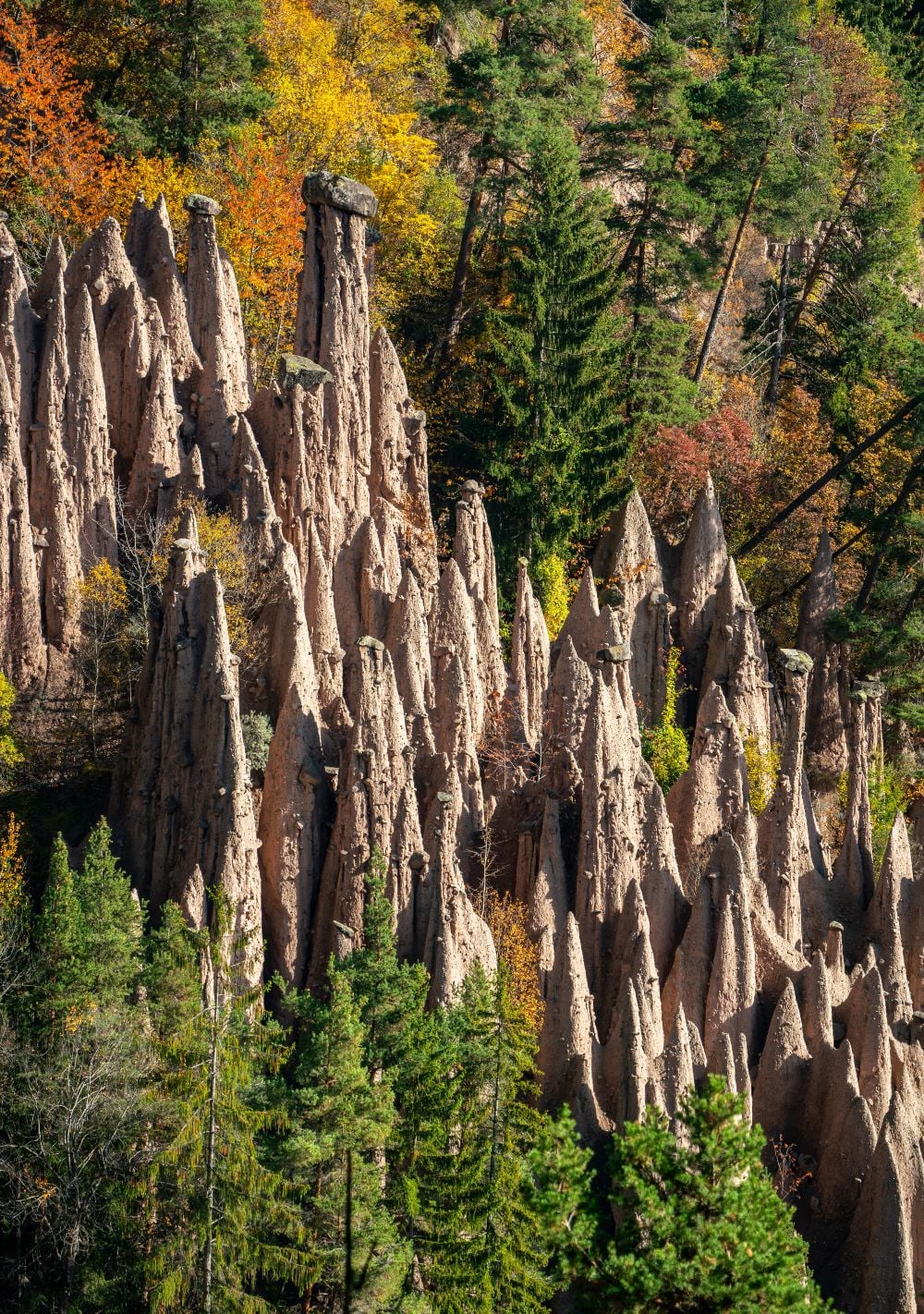
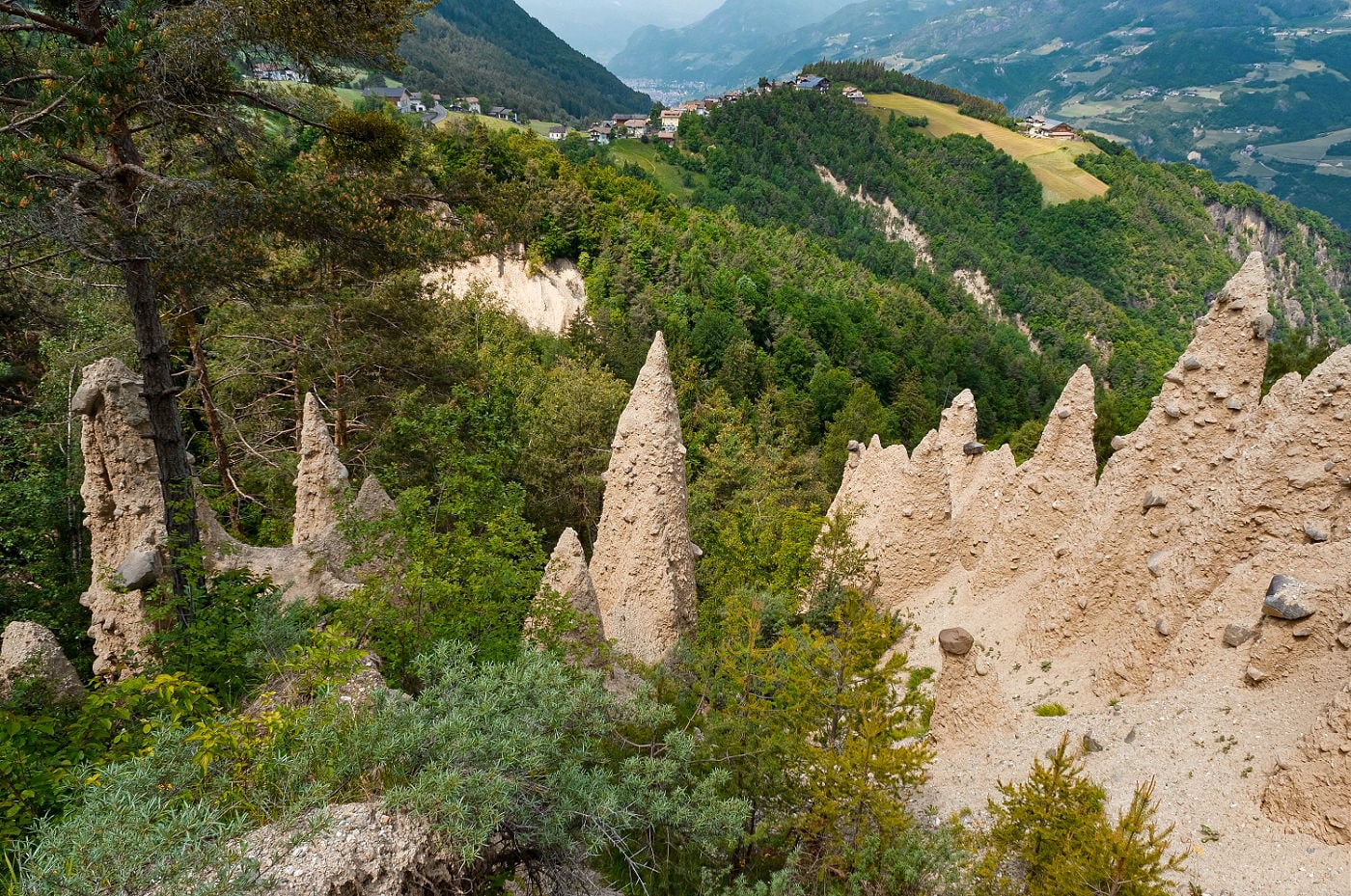
The truth, though, is somehow nearly as strange. These soaring spires are glacial debris, clay slowly carved apart over thousands of years by rain and erosion, while the enormous boulders perched on top act like umbrellas, shielding the earth directly beneath them. Lose the capstone and the protection is gone. The column begins its own slow disappearance.
This bizarre geological dance makes Renon one of those places where the explanation is almost as interesting as the sight itself. And because the pyramids sit within easy reach of Bolzano, they are also remarkably simple to visit. Especially if you pair them with a ride on the Renon cable car and railway, a village stop or two, and time to explore the plateau beyond.
Visiting the Earth Pyramids
Renon has several groups of earth pyramids, but the ones we visited rise from the Finsterbach gorge near the hamlet of Lengmoos (Longomoso), just outside Klobenstein (Collalbo), the main village on the plateau.
For something that looks so thoroughly inconvenient, they are remarkably easy to reach. The walk from Lengmoos is short and mostly level, following a broad path toward the gorge until the forest suddenly gives way and the earth drops out in front of you. Across the ravine stand the pyramids, packed along the steep slope beneath the trees.
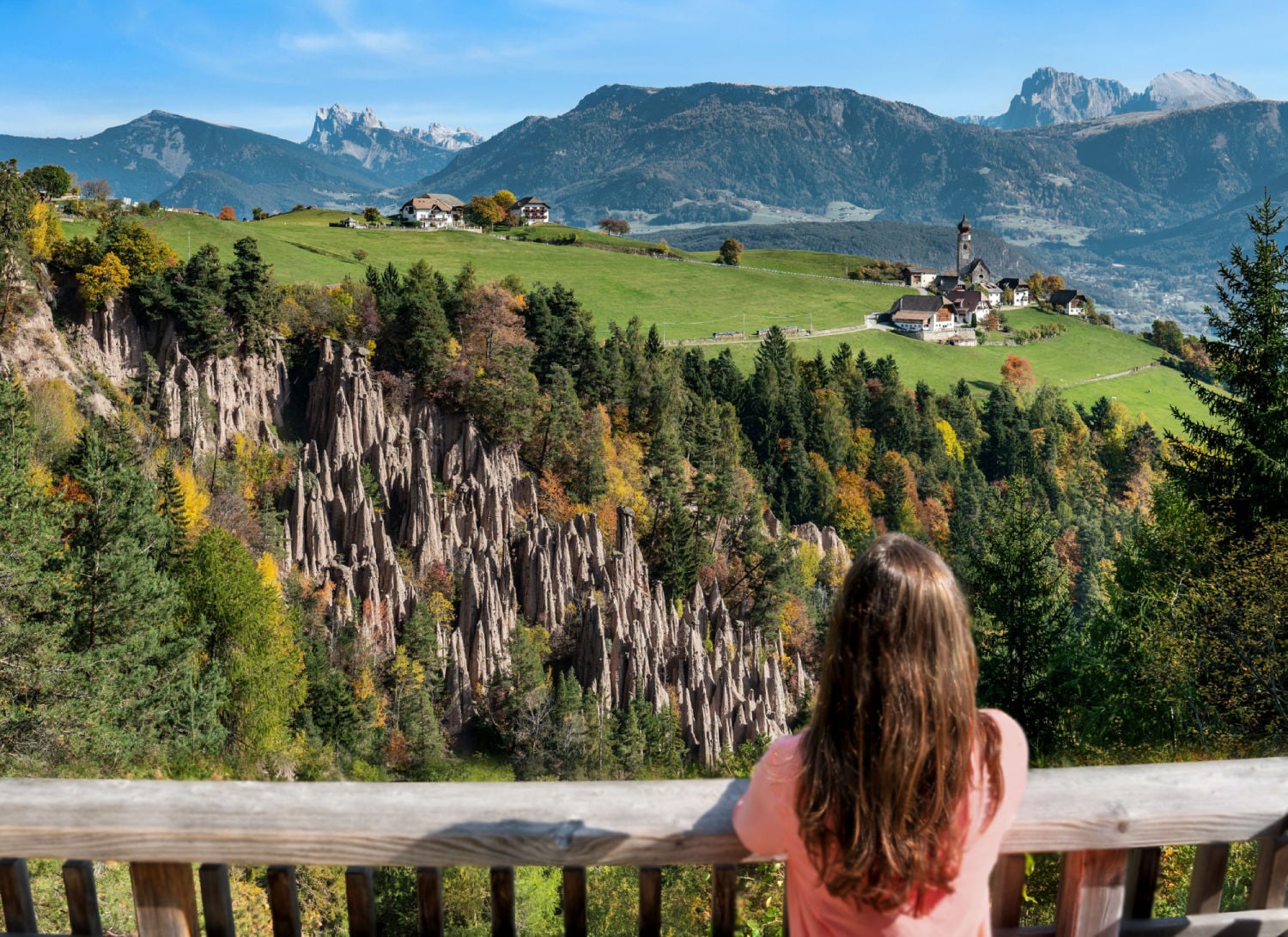
And this is where photographs fail them. Online, they tend to look like odd little spikes of dirt. In person, some rise higher than the surrounding trees, their enormous capstones sitting overhead at angles that appear to violate several basic agreements between rocks and gravity.
We had seen plenty of pictures beforehand. They did not prepare us for the scale. Nor for how precarious the whole scene looks.
You do not walk among the pyramids themselves. Viewing platforms keep you safely on the opposite side of the gorge, which is probably for the best. These are, after all, towers of eroding clay holding very large rocks above very empty space.
Behind the pyramids, the Dolomites pile up across the horizon: the jagged ridgeline of Seceda rising beyond Resciesa, Sassolungo above Alpe di Siusi, and the great block of Schlern — South Tyrol’s most recognizable mountain.
📌 Good to Know: Lengmoos is not a hike you need to gear up for. If the Earth Pyramids are your only objective, this is an easy outing rather than a mountain excursion. The real opportunity is to make them one stop in a broader day exploring Renon.
How the Earth Pyramids of Renon Were Formed
Mother Nature has a surprisingly simple recipe for making an earth pyramid: glacial debris, large rocks, rain and an obscene amount of time.
At the end of the last Ice Age, roughly 25,000 years ago, retreating glaciers left thick deposits of moraine across Renon. Think of moraine as the Earth’s equivalent of a junk drawer: clay, sand, gravel, stones and enormous boulders all dumped together with very little concern for organization.
Then the weather went to work. The clay behaves almost like two different materials depending on how much water it contains. When dry, it can become remarkably hard. Saturate it with rain, however, and it softens enough to wash and slide away.
That should eventually erase the entire slope. Except for the boulders.
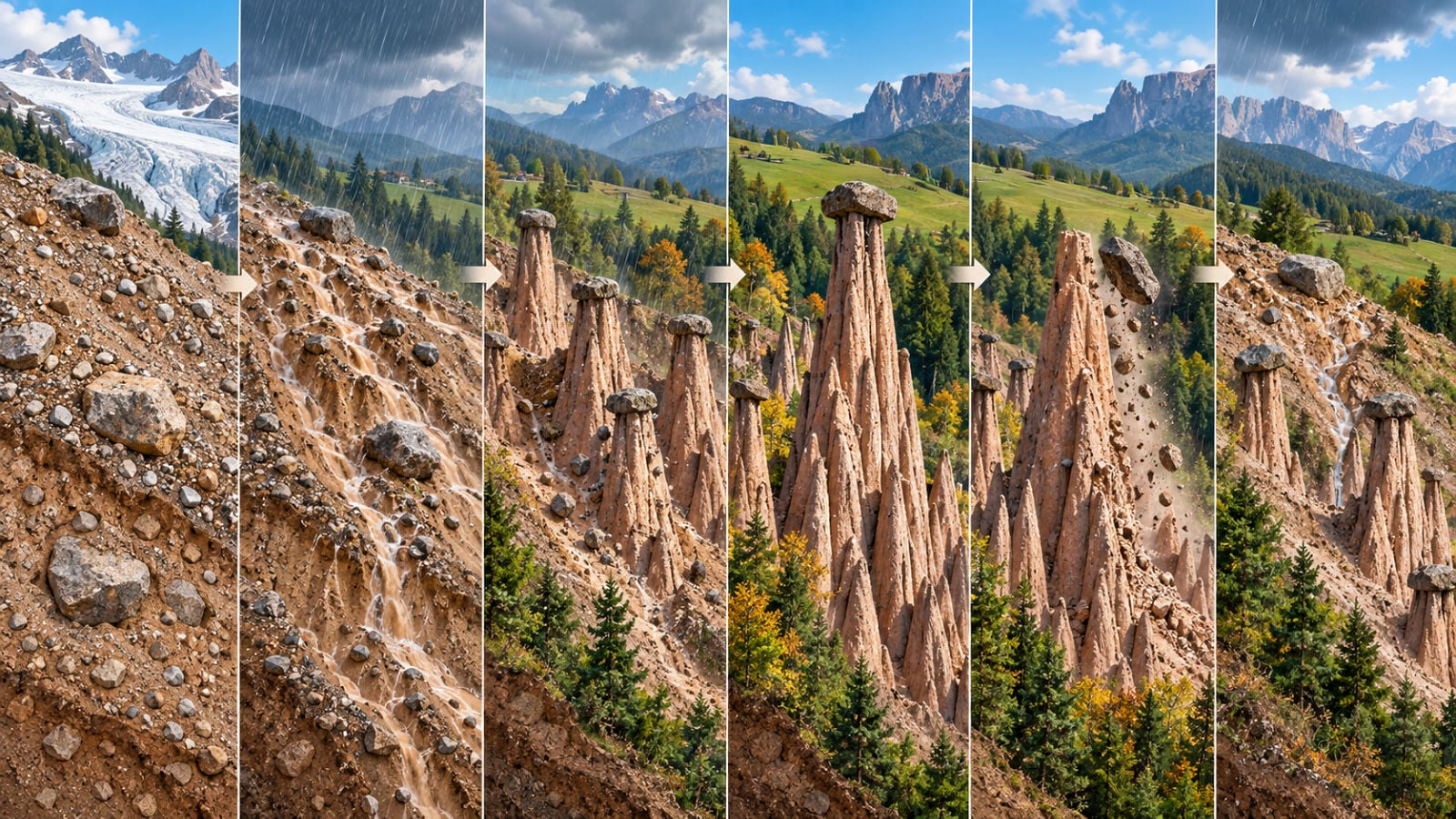
Where a large stone happens to sit, it acts like a hard hat, shielding the clay beneath it from rain while the surrounding slope slowly washes away. Over time, that protected patch becomes a column, with the boulder perched on top.
The moment the hard hat falls off, the pyramid is doomed. But not before taking on one last form: a bare clay spike, sharpened by the rain as it eats away at the newly exposed earth. Eventually, erosion wins, and the column disappears altogether.
Meanwhile, higher up the slope, another buried boulder may be emerging and protecting the beginnings of a new one. So the Earth Pyramids are not finished formations in the way we tend to think of cliffs, peaks or caves.
They are caught somewhere in the middle. Renon is still making them. And still tearing them down.
📌 Good to Know: Locals did not traditionally call them pyramids. The old South Tyrolean term is Lahntürme — literally “landslide towers” — which is less romantic and considerably more honest. Today, Erdpyramiden (“earth pyramids”) is the term most commonly used in tourism and scientific contexts.
How to Get to the Earth Pyramids of Renon
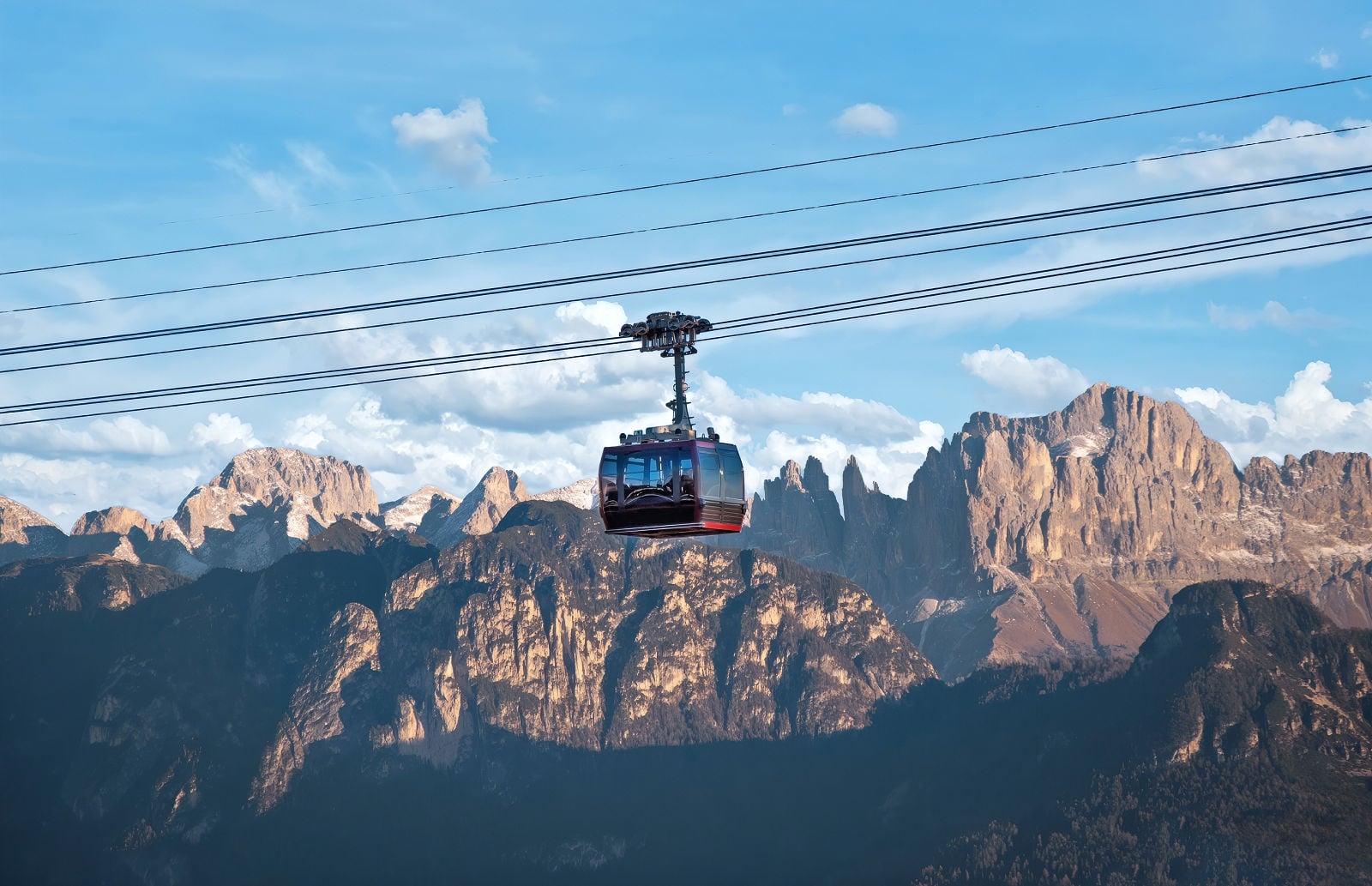
If you are driving while in Italy, you can certainly cruise up the plateau to Lengmoos. Parking is located just beyond the Maria Himmelfahrt Parish Church.
However, if you are starting in Bolzano, skip the drive. The better approach is to let Renon reveal itself in stages: first by cable car, then by railway, then on foot.
Take the Renon Cable Car from Bolzano
The Renon cable car lifts you from Bolzano to Oberbozen (Soprabolzano) in about 12 minutes.
Bolzano drops away beneath you, vineyards begin climbing the slopes, and the basin opens wider with every passing minute. On a clear day, the Dolomites gather across the horizon while the city recedes thousands of feet below.
Then the doors open and you are standing on a mountain plateau. No switchbacks. No grinding uphill traffic. No regretting the second krapfen at breakfast.
Ride the Rittner Bahn to Klobenstein
From Oberbozen, transfer to the Rittner Bahn, a railway that has been crossing Renon since 1907.
The trip to Klobenstein takes roughly 18 minutes and is worth doing even if the train deposited you absolutely nowhere useful. Thankfully, it does. The little railway clatters through meadows and farm country, stopping at small settlements along the plateau before reaching Klobenstein.
Walk from Klobenstein to Lengmoos
From Klobenstein station, follow signs for Lengmoos and the Erdpyramidenweg / Trail No. 24.
The walk takes about 30 minutes and is mostly level, passing through the village before continuing toward the Finsterbach gorge.
Eventually the path reaches the viewing area, the ground falls away, and those improbable clay towers appear across the gorge.
📌 Good to Know: If you are staying in Bolzano, taking the cable car and railway turns what could be a quick sightseeing stop into a much better half-day outing. The transportation is not dead time. It is part of the day.
When to Visit the Earth Pyramids of Renon
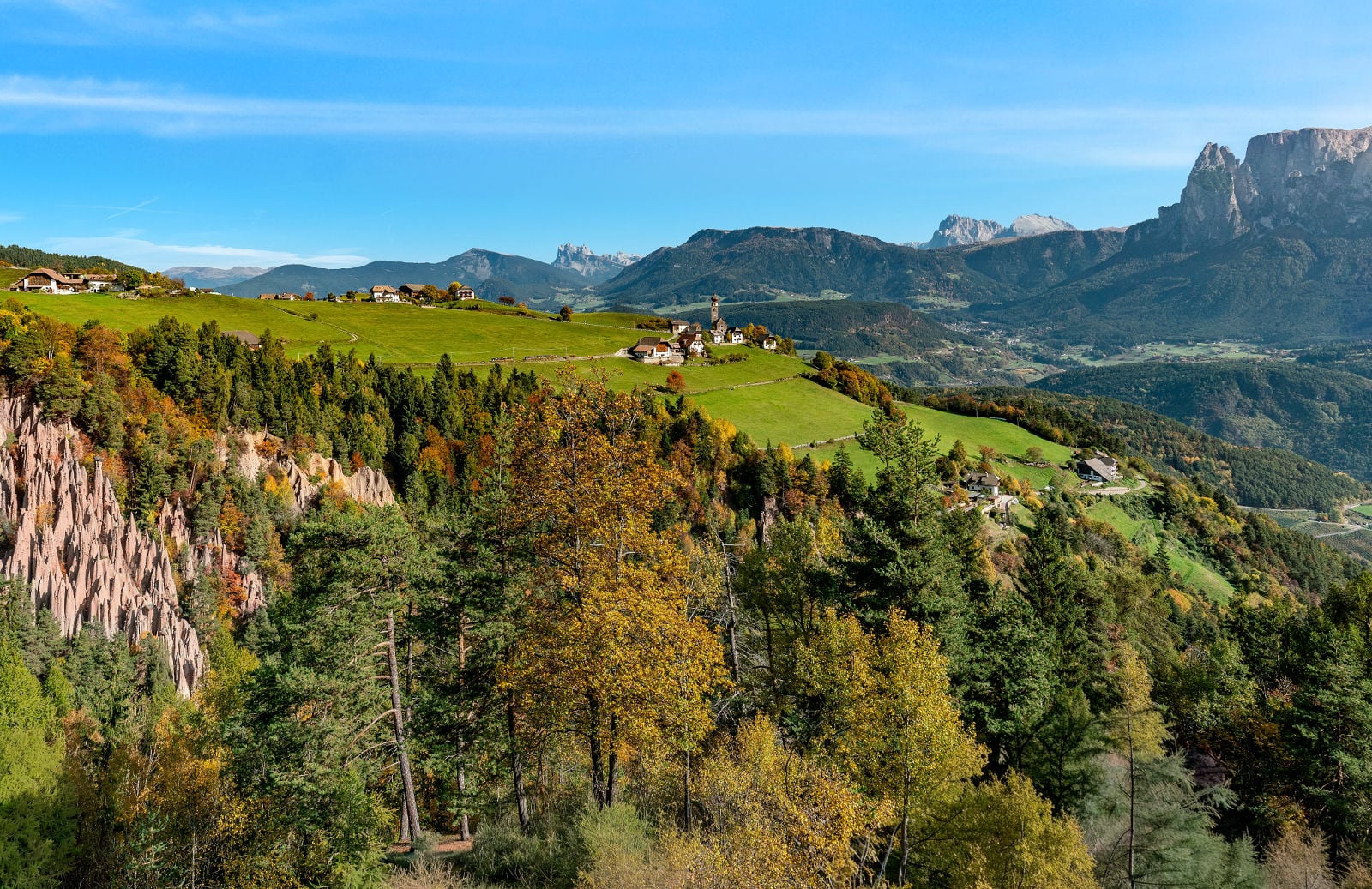
We visited the Earth Pyramids twice, both in autumn, and if we had to choose again, we would go right back at roughly the same time.
By then, summer has started to loosen its grip on the plateau. The light sits lower, the crowds thin out in South Tyrol, and the autumn colors make the scene even more surreal.
If you are a photography enthusiast, that lower light matters. The Earth Pyramids are all texture. Ribs, cuts, and crumbling faces of clay. High midday sun tends to flatten them. Side light catches every fold and makes the formations look considerably more dramatic.
Summer is still a perfectly good time to visit, especially if you are using Renon as an escape from the heat in Bolzano. You also get long days for combining Lengmoos with more of the plateau.
Spring can work beautifully too, although prolonged rain is worth paying attention to here for obvious reasons. These formations exist because water is actively dismantling the hillside. After poor weather, check current trail conditions before heading out.
Winter changes the scene entirely. Snow around the pyramids can be striking, but ice and winter weather make the walk a different proposition from the easy outing you get in warmer months. If you are visiting the Dolomites in winter, adding a day on Renon can also be a welcome change of pace from the ski slopes, or a quiet break from the bustle of Bolzano’s Christmas market during the holiday season.
Make a Day of It on Renon
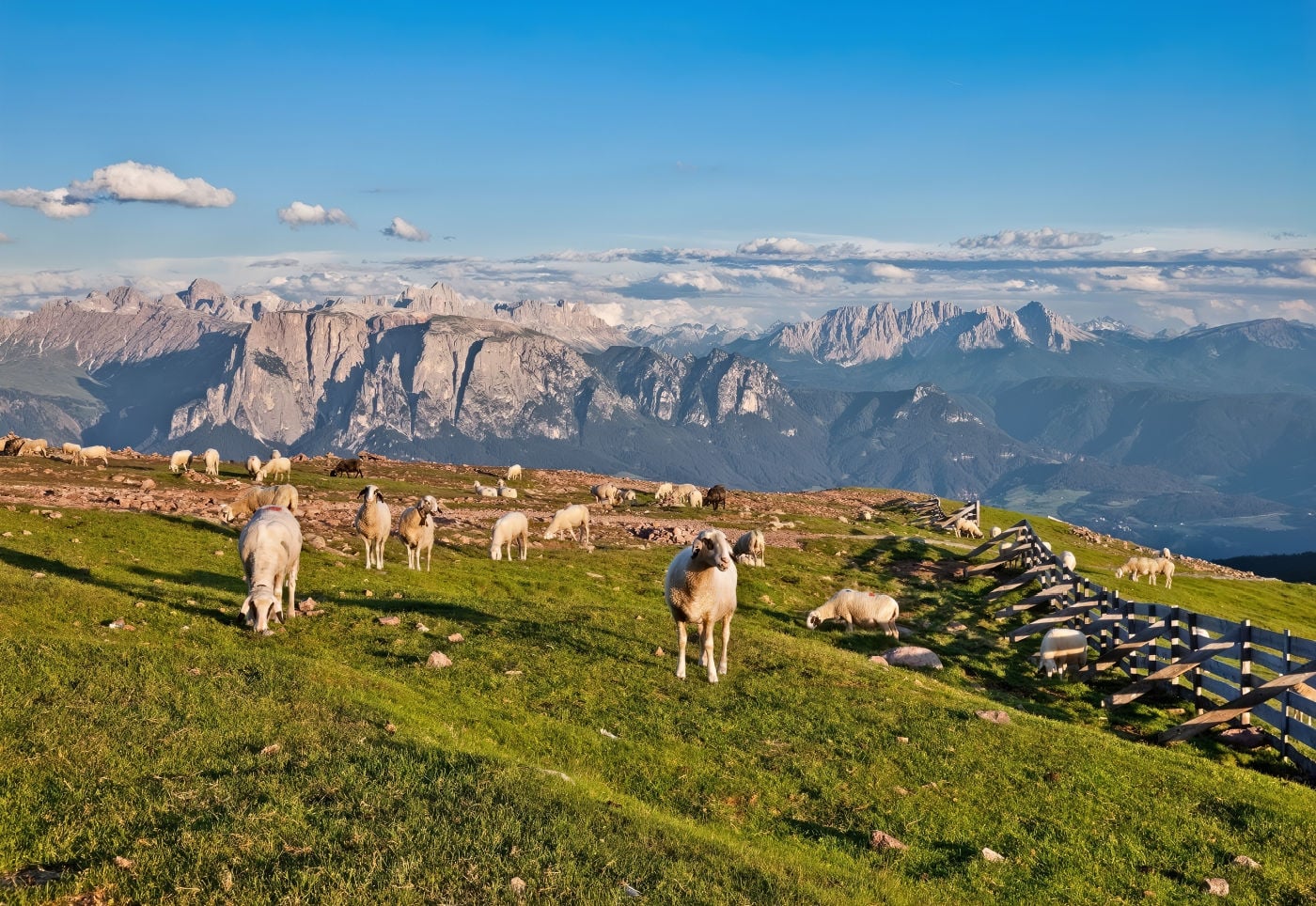
The Earth Pyramids are worth seeing, but we would not ride up to Renon, look at them for an hour, and immediately head back to Bolzano. The plateau deserves more than that.
Depending on how much time you have, you could wander through Klobenstein, ride the Rittner Bahn farther across the plateau, walk through the old summer retreat of Maria Himmelfahrt, head toward the Rittner Horn if you want to put some actual mountain scenery into the day, or enjoy a Törggelen experience if you are visiting in autumn.
There are also easy walks, farm stops and places to settle in for lunch without turning the outing into another full hiking day.
The trick is deciding what actually fits together. Renon is larger than it looks on a map, and the cable car, railway, villages and walking routes can make a day feel either wonderfully unhurried or unnecessarily complicated depending on how you string them together.
That is where we would resist the urge to cram everything in. See the pyramids. Pick one or two other things that genuinely interest you. Leave enough time to enjoy the plateau rather than simply collecting stops.
📌 Good to Know: If you would rather have us sort through those choices for you, our custom itinerary planning service is built around exactly this kind of decision: figuring out what belongs in the same day, what is worth your time, and what should be left for another trip.
Other Earth Pyramids on Renon
As we mentioned earlier, Renon has more than one group of earth pyramids. There are three separate groups in three separate ravines, and there are more scattered across the rest of South Tyrol.
We went to Lengmoos, which is the tallest group and by some distance the easiest to reach. We have not yet visited the other two on the plateau, so we are not going to pretend otherwise. Here is where they are and how they differ, so you can judge which one your day actually suits.
Oberbozen / Soprabolzano Earth Pyramids
These rise below the village in the Rivellaun ravine. They share the same reddish-brown coloring as Lengmoos, but the columns crowd together on steeper terrain, giving the formation a denser, more dramatic appearance. Reaching them requires a walk from the village rather than the short stroll you get at Lengmoos.
Unterinn / Auna di Sotto Earth Pyramids
The formation near Unterinn sits in the Gasterer Graben and looks noticeably different from the other two. Instead of rusty red earth, these pyramids are formed from much paler, almost whitish material. They are also the least visited of the three, helped in part by the fact that access was more difficult before the trail and viewing platform were improved.
📌 Good to Know: The Keschtnweg, South Tyrol’s Chestnut Trail, passes the Unterinn pyramids and can be incorporated into a longer route from Oberbozen.
Earth Pyramids Elsewhere in South Tyrol
Renon has the largest and best known group of earth pyramids, but it is not the only place they occur. If you are based somewhere else in the region, you may not need to drive to Bolzano at all.
- Dorf Tirol — An easy one to work into a day around Merano and Tyrol Castle. Earth pyramids rise from the Mutabach gorge below the slopes of the Texel Group, and they can be seen while hiking in the area around the castle.
- Percha — The best alternative if your trip is focused on the Eastern Dolomites. Located just outside Bruneck, the pyramids can be reached on a relatively easy forest walk, making them a practical addition when traveling to or from places such as Lago di Braies, Prato Piazza or Tre Cime di Lavaredo. They can also be a worthwhile lower-elevation option on a cloudy day when the high mountains are socked in.
- Terenten — Another Pustertal option, but farther west than Percha. These pyramids fit especially well if you are traveling between Brixen and Bruneck. A pleasant way to see them is along Terenten’s Mill Trail, a 2.8-mile (4.5 km) loop that passes historic mills as well as the pyramids.
- Steinegg — A good choice if you are exploring the Eggental / Val d’Ega, particularly if Lago di Carezza is already on your itinerary. The pyramids are reached on a roughly 3.5-mile (5.7 km) circular hike through forest, meadows and the Katzenbach gorge.
Are the Earth Pyramids of Renon Worth Visiting?
Yes, particularly if you are staying in Bolzano or already planning to explore Renon. These are strange and genuinely unlike anything else in the Alps. That said, we would not sacrifice a prime hiking day in the Dolomites solely for the Earth Pyramids, but paired with the cable car, Rittner Bahn and a few hours on the plateau, they make for a very worthwhile half-day or easy day between bigger mountain outings.
Save & Pin for Later
Grab the free guide + follow for South Tyrol + Dolomites travel tips
25 Things to Know Before Visiting the Dolomites
Join 18,000+ travelers. No spam, ever.