Peitlerkofel — also known as Sass de Putia — is among the most peculiar mountains in the Dolomites and the star of one of its best circuit hikes. Circling this hulking massif serves up a full day of high-alpine scenery, rolling meadows, moody forests, and one exhilarating push to a saddle that transforms the entire character of the route.
The first time we saw Peitlerkofel was on a hike to the historic St. Barbara Church above the whisper-quiet village of La Val in South Tyrol’s Alta Badia. From that side, the mountain did not read as pastoral or picturesque. It looked like a locomotive heaving out of the heavens, all bulk and momentum, barreling toward some destination not meant for mortals like us. As much as we admired the little church clinging to the hillside, our attention kept drifting back to that strange, commanding massif on the horizon.
That night, we found it on a map, fixed its name in memory, and started plotting a way into the orbit of this great, improbable hunk of stone that had steamrolled into our minds. We discovered a trail circling the massif starting from Passo delle Erbe — also known as Würzjoch in German and Jü de Börz in Ladin — a mountain pass perched between Val Badia (Gadertal) and Val di Funes (Villnöss).
The route promised not just a closer look, but a full day of the kind of contrasting scenery we love in the Dolomites: high-alpine drama and geologic intrigue on one side, rolling pastures and forests on the other, and enough shifts in temperament to make the whole day feel like a bolt of schnapps. What follows is everything you need to know to enjoy the Peitlerkofel Circuit, locally known as the Rundweg Peitlerkofel, as much as we did.
Peitlerkofel / Sass De Putia at a Glance

What is Peitlerkofel: Peitlerkofel is a 9,432 ft (2,875 m) solitary massif in the Dolomites’ Puez-Geisler Nature Park (Puez-Odle), sitting on the boundary between Val Badia and Val di Funes in South Tyrol. It goes by three official names depending on which language you’re speaking: Peitlerkofel in German, Sass de Putia in Italian, and Sas de Pütia in Ladin. In Krampus tongue, the translation is less exact, but sounds notably threatening.
What makes Peitlerkofel so special: Unlike many Dolomites hikes that are about traversing a broad chain of peaks, this one revolves around a single mountain. At the top, Peitlerkofel divides into two summits — Grosser Peitler at 9,432 feet (2,875 m) and Kleiner Peitler at 9,229 feet (2,813 m) — with a deep cleft between them. Add in the dramatic ascent to Peitlerscharte / Furcela de Pütia, and you have one of South Tyrol’s best moderate hikes for travelers who want variety without committing to a highly technical route.
What is the Peitlerkofel Circuit: The Peitlerkofel Circuit, also called the Sass de Putia loop, is a roughly 8 mile (12.8 km) hike that circles the mountain from Passo delle Erbe (Würzjoch). It typically takes 4.5 to 5 hours and has an elevation gain around 2,100 feet (640 m) of elevation. We recommend hiking the circuit counterclockwise. Trail numbers: 8A → 4 → 4B → 35 → 8B → 8A.
Best time to hike Peitlerkofel: The usual hiking window runs when the huts are open from mid-June through early October, though conditions vary with snowfall. We hiked it in early October and contended with snow and ice on parts of the circuit.
Where to eat on the circuit route: Five mountain huts serve food along the route: Ütia Ćir, Munt de Fornella, Ütia Sot Pütia, Ütia Vaciara, and Ütia de Göma. In addition, you can dine at Ütia de Börz near the trailhead.
Best place to stay overnight to hike Peitlerkofel: To experience the magic of sunrise and sunset igniting the face of Peitlerkofel, we recommend staying at Ütia de Börz, which is located directly at Passo delle Erbe.
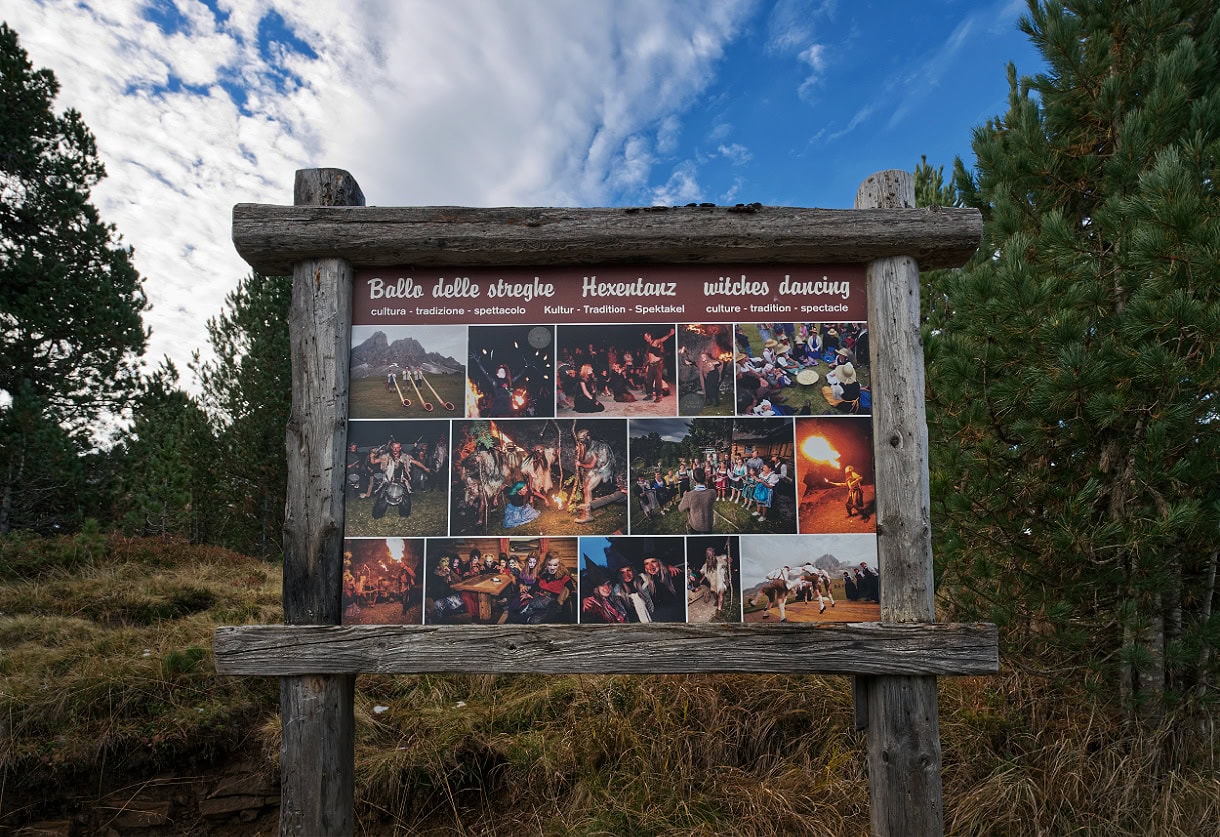
Cultural highlight: Peitlerkofel is tied to local folklore through Bal dles Stries (Hexentanz) — the Witches’ Dance — a tradition based on the old belief that witches once gathered beneath the mountain at Passo delle Erbe. Held annually in late July, the event turns that legend into a memorable summer night of costumes, storytelling, music, bonfires, and local food beneath the walls of Sass de Putia. It is both celebration and cultural memory, preserving an older way of understanding the mysterious power of the high mountain world.
Where is Peitlerkofel?
Peitlerkofel is one of the northernmost mountains in the Dolomites and anchors the northern end of Puez-Geisler Nature Park in South Tyrol, on the boundary between Val di Funes to the west and Val Badia to the east.
The circuit hike starts at Passo delle Erbe, a high mountain pass pinned beneath Peitlerkofel’s northern face at nearly 7,000 feet (2,006 m). If you are not staying near base of the mountain, it is a great day hike option from several South Tyrolean bases:
- St. Magdalena (Santa Maddalena) or St. Peter (San Pietro) in Val di Funes (~30 minutes)
- San Martino in Badia (~25 minutes)
- Antermoia (Untermoi), less than 10 minutes from the pass
- Brixen (Bressanone), roughly a 1-hour drive
- Bolzano, roughly a 1.5 hour drive
One thing we noticed right away: this corner of the Dolomites feels different from the more resort-driven and commercialized parts of the region. The road up is narrow, the setting is more remote and rural, and the surroundings seem more tied to the realities of mountain life. In a landscape this wild, it is no mystery how myths and witch folklore came to take hold.
Getting to Passo delle Erbe (Würzjoch)
By Car: A paid parking lot, Parkplatz Würzjoch, sits directly at the pass, across from Ütia de Börz. Both roads to the pass are narrow, single-lane mountain routes. If you’re uncomfortable with tight alpine driving in Italy — especially when an oncoming vehicle appears around a blind bend — consider taking the public bus. We had to back up twice to a pull over to let a tractor through. That said, the views en route over Val di Funes made us quickly forget the brief white-knuckle sections of the drive.
By Public Bus: Passo delle Erbe is served by public bus during the hiking season. Pick up our Trip Planner for help navigating South Tyrol’s public transportation network and planning hikes like this one with less guesswork.
How to Hike the Peitlerkofel Circuit
The moment you arrive at Passo delle Erbe, Peitlerkofel makes its presence known. Its northern face looks nothing like the locomotive profile we had admired from the village of La Val. Here, the mountain looks like a prehistoric sea monster, a hunter of shadows surging up from the depths, all fins, spines, and horns thrusting through the surface of the earth.
The best way to circle this ancient beast is to hike it counterclockwise. To make it easy to digest the hiking directions, we’ve broken the route into four segments: The Geological Scars of the Dolomites, The Climb to Forcela de Pütia, Through the Peitlerwiesen Meadows, and The Bewitching Return.
Segment 1: The Geological Scars Of the Dolomites
The circuit hike begins at Parkplatz Würzjoch, located directly opposite Ütia de Börz at Passo delle Erbe. Take a right onto trail no. 8A, which leads past Ütia Ćir, where you can grab a coffee or hot chocolate before continuing into a thicket of stone pines.
This stretch immediately enlivens your senses. Stone pine is celebrated in the Alps for its fresh, restorative scent. You will find it in alpine wellness rituals, herbal products, and even traditional wood interiors designed to promote calm and rest.
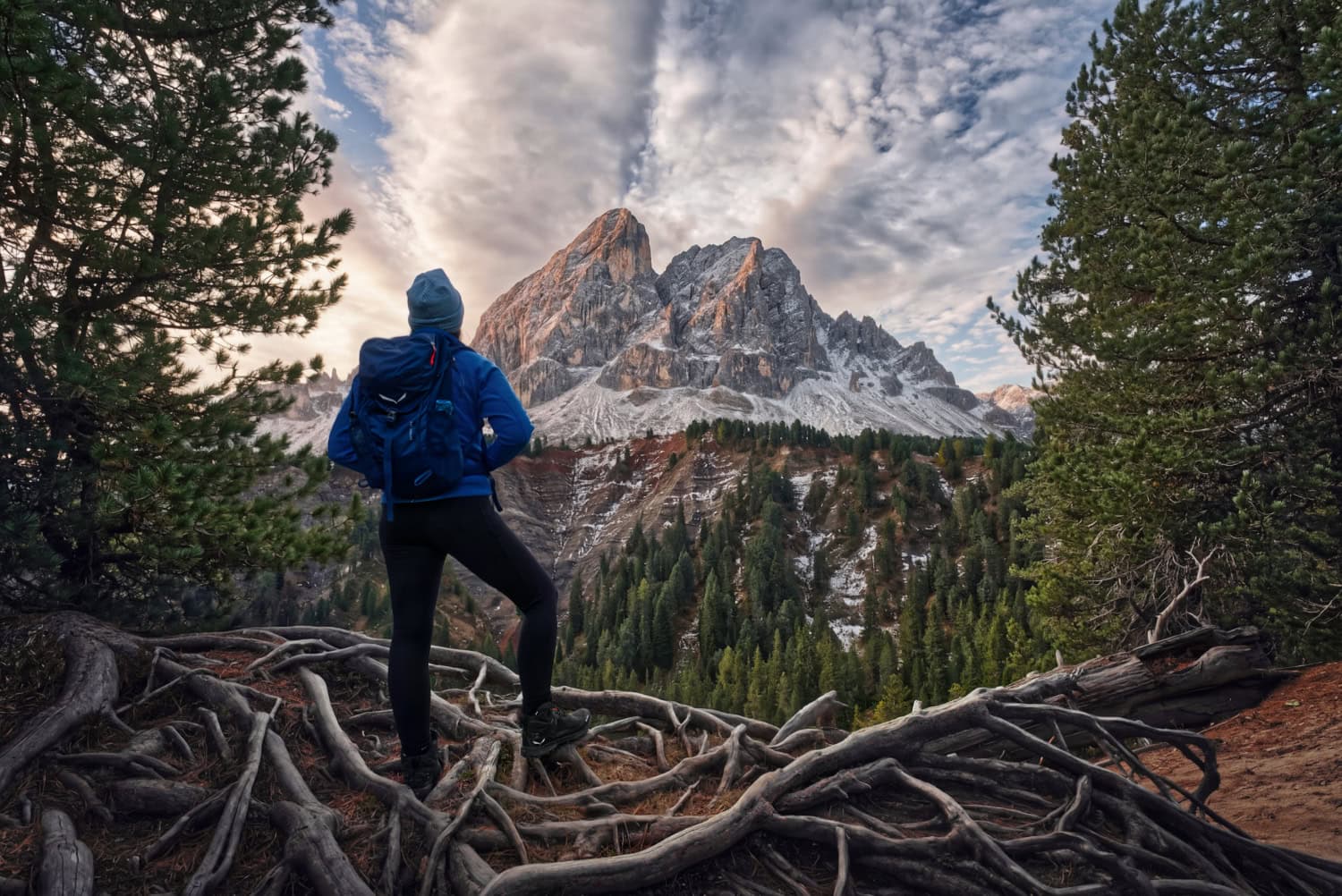
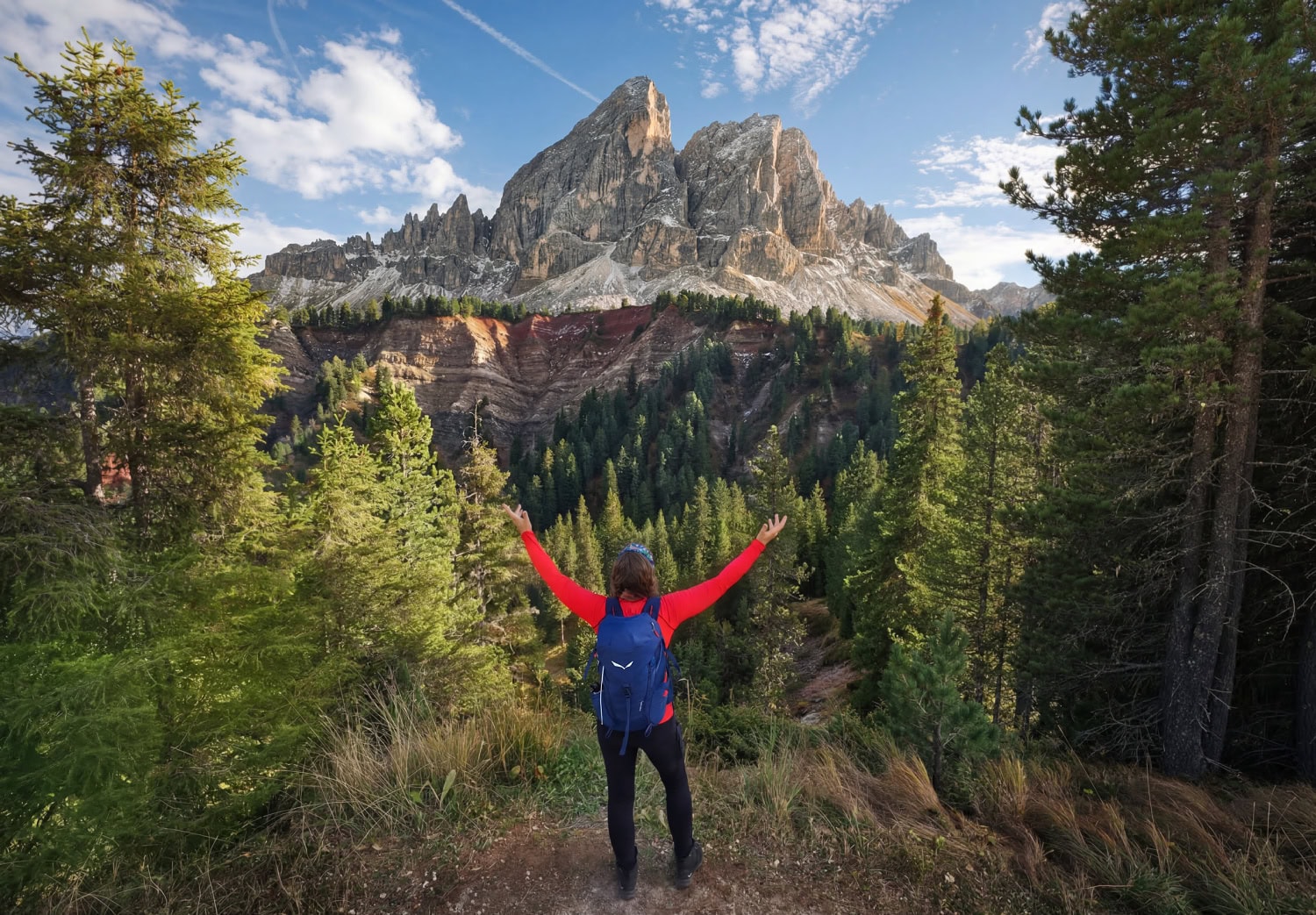
Shortly, the trees part amid a tangle of roots. The view you encounter is unsettling. Peitlerkofel reveals itself with such thunderous authority that it feels as if you are barging into the presence of God. There is a force to this place, a primal pull beyond words, but not beyond recognition.
Here, you can gaze into the belly of Peitlerkofel, study its deep geological scar, and take in one of the best photo spots on the circuit. What you are looking at is known as the Gröden Formation: Permian-age sandstone, roughly 200 million years old, exposed in horizontal bands of dark rust-red and pale grey.
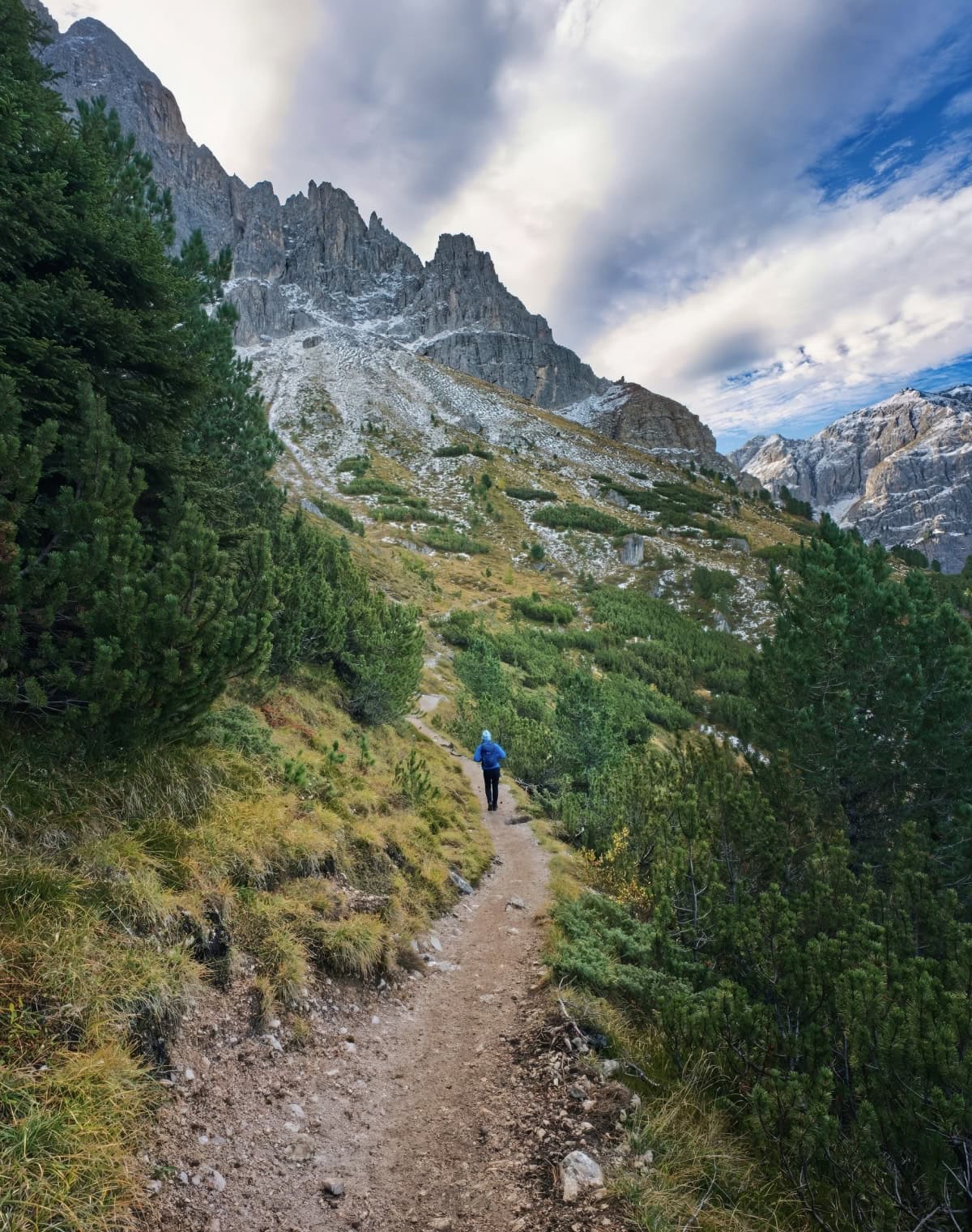
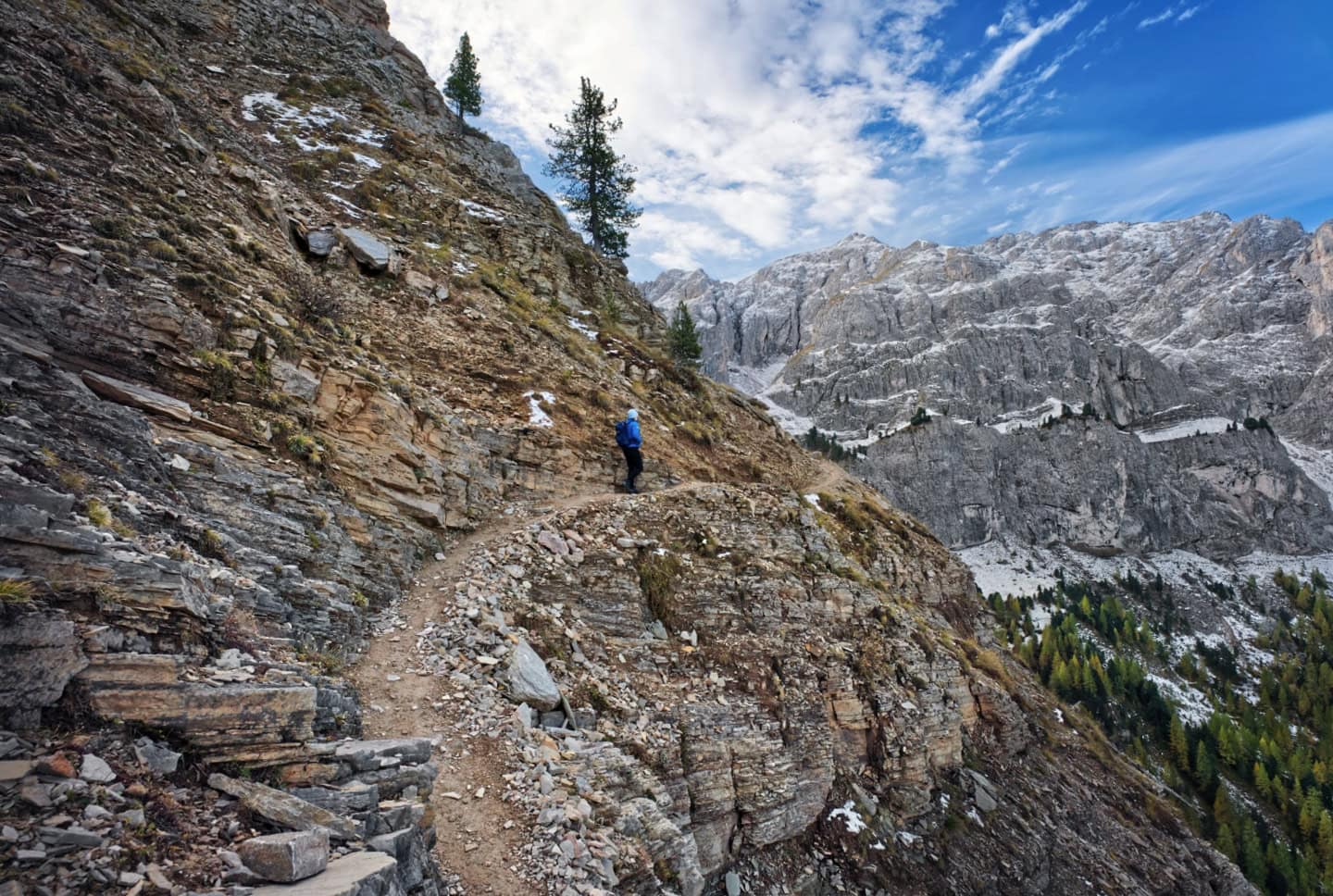
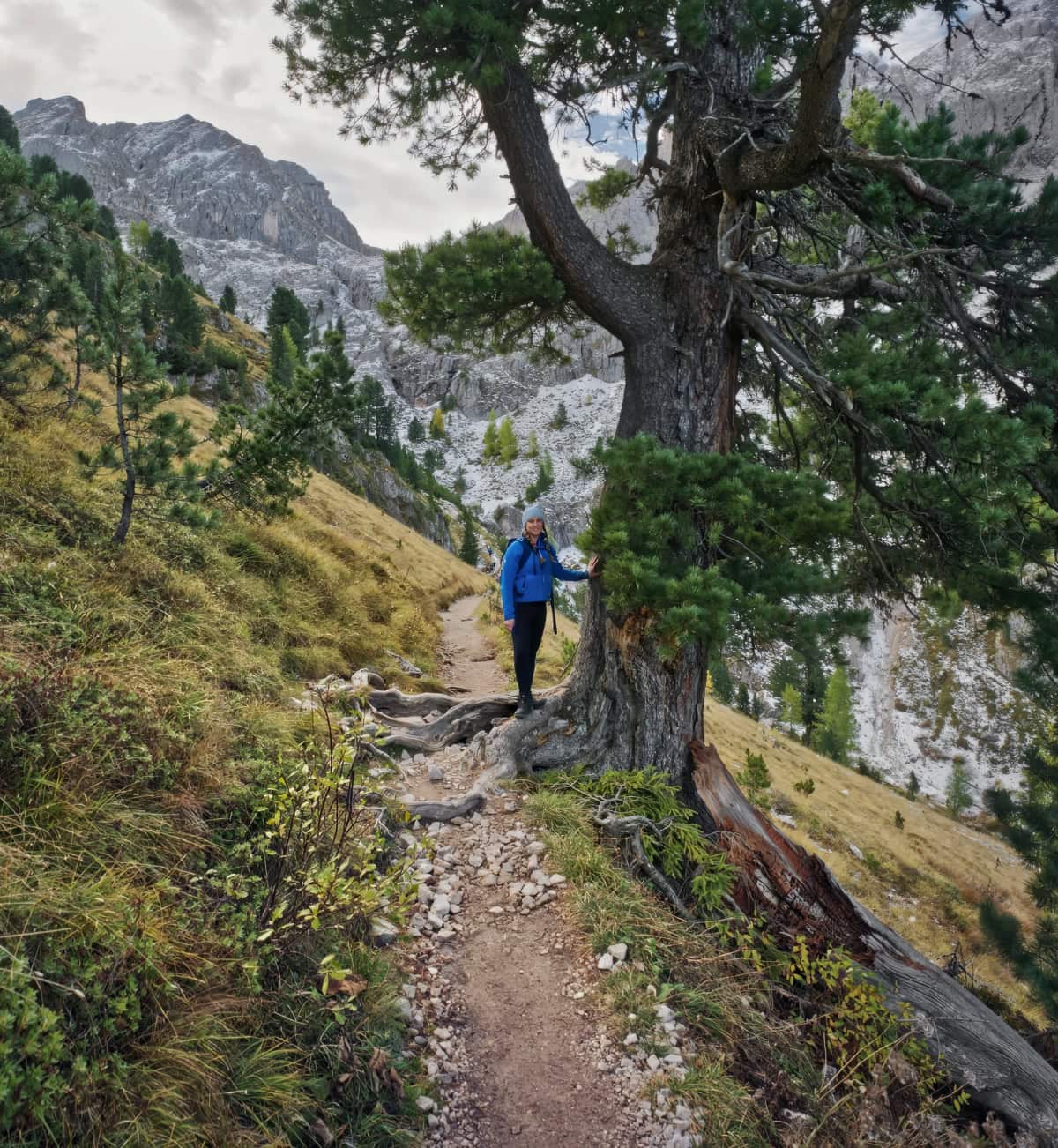
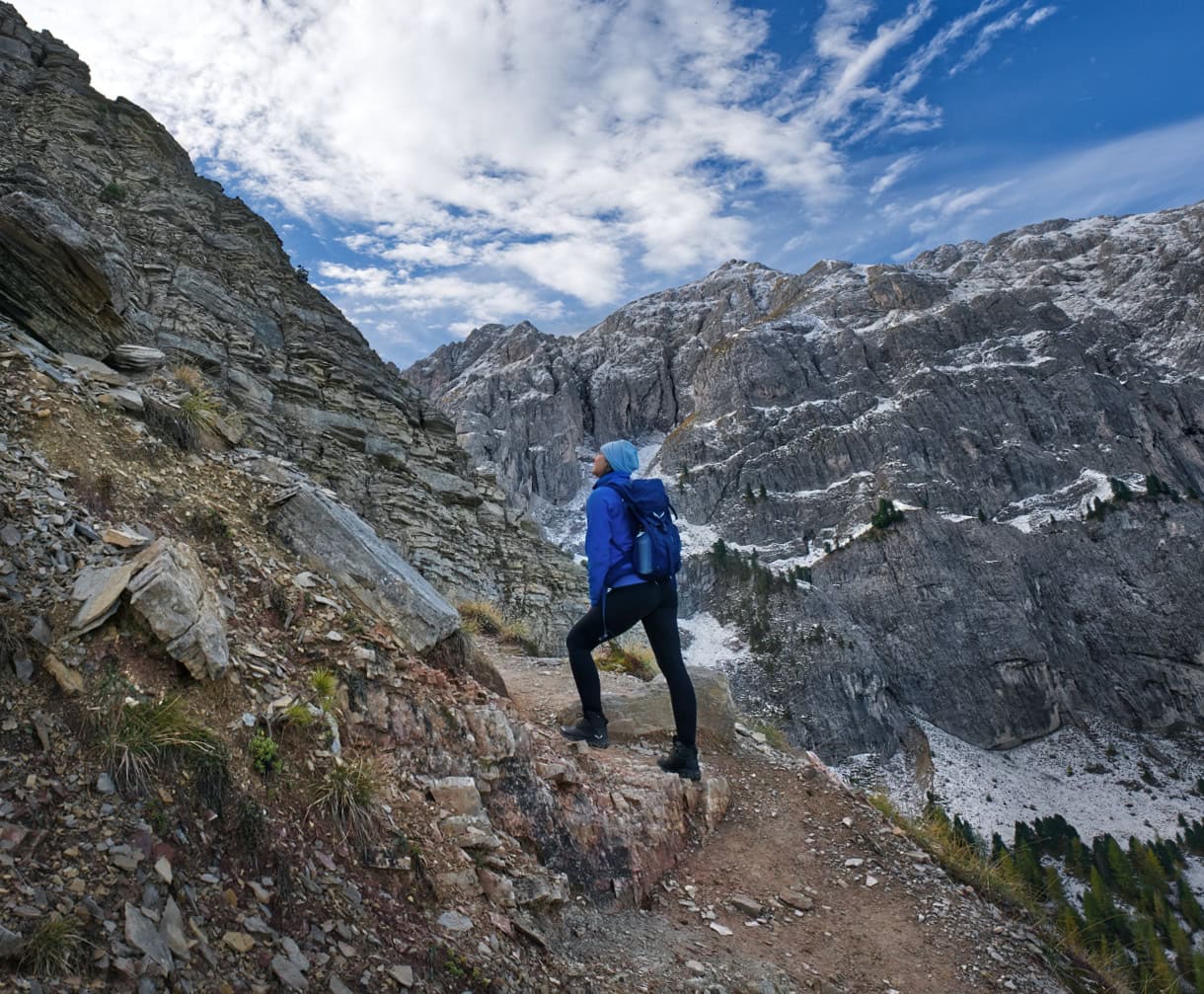
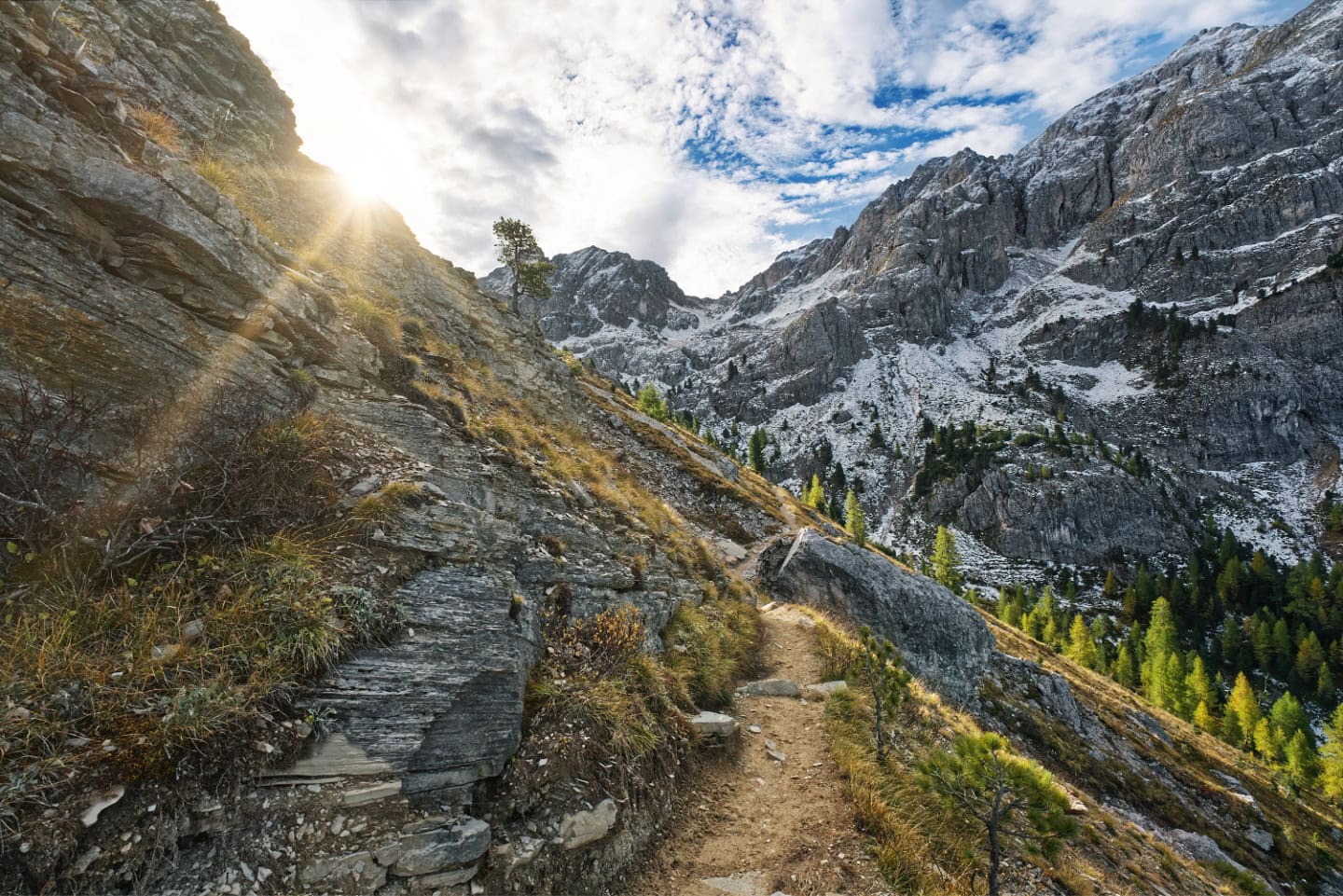
These striped layers of earth and rock predate the Dolomite limestone rising above them by tens of millions of years. Their red coloring comes from iron oxide in ancient desert sediment. You can witness the same geological phenomenon along the Seceda ridgeline.
The path continues through heather and bilberry before eventually arriving at a sprawling alpine meadow beneath Peitlerkofel. Here, you’ll spot the Munt de Fornella and Ütia Sot Pütia huts. You can visit either one if you’d like a break before beginning the mountain ascent or make to plans to visit them on the return.
Continue following trail no. 8A to the right toward the Peitlerscharte / Furcela de Pütia. You will eventually begin skirting the mountain on its northwestern flank on a much narrower path. As you climb, views open to the Aferer Geisler (Odle di Eores) massif, which beyond lies Val di Funes and the Adolf Munkel Trail.
Segment 2: The Climb to Forcela de Pütia
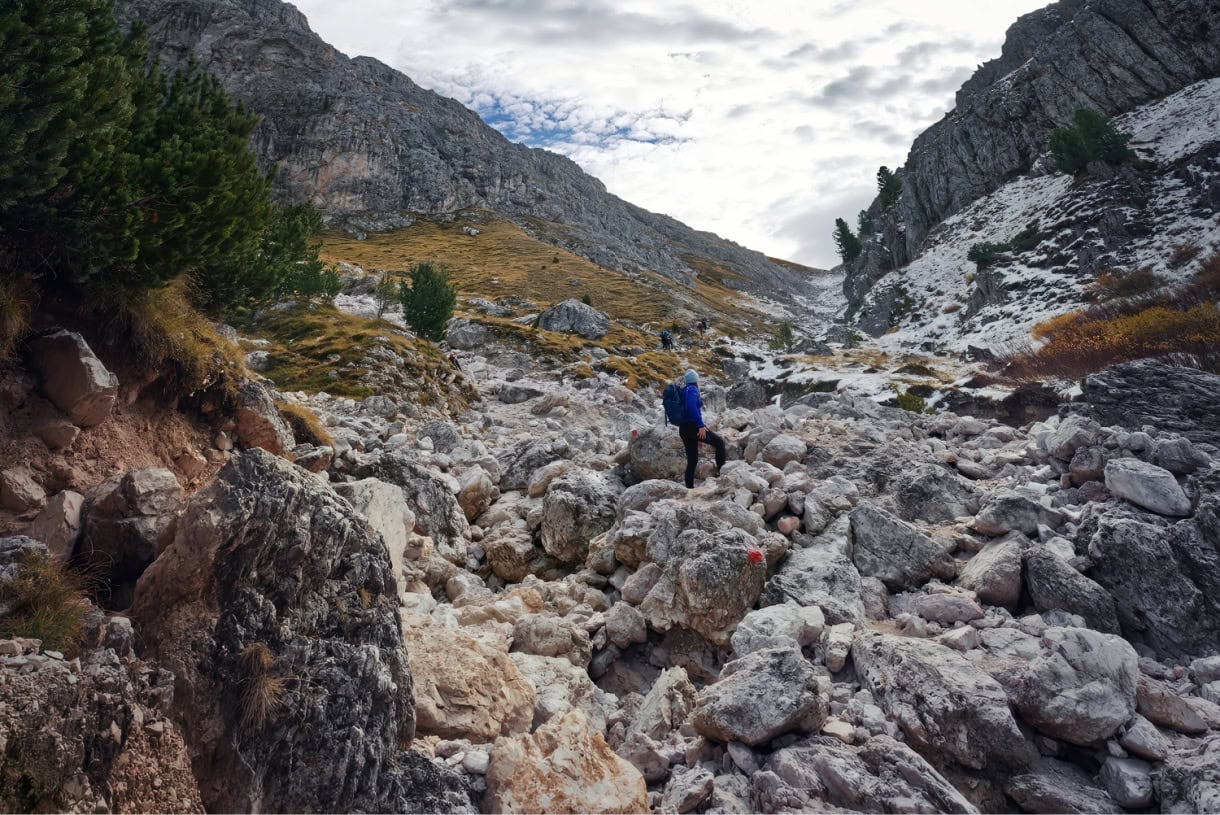
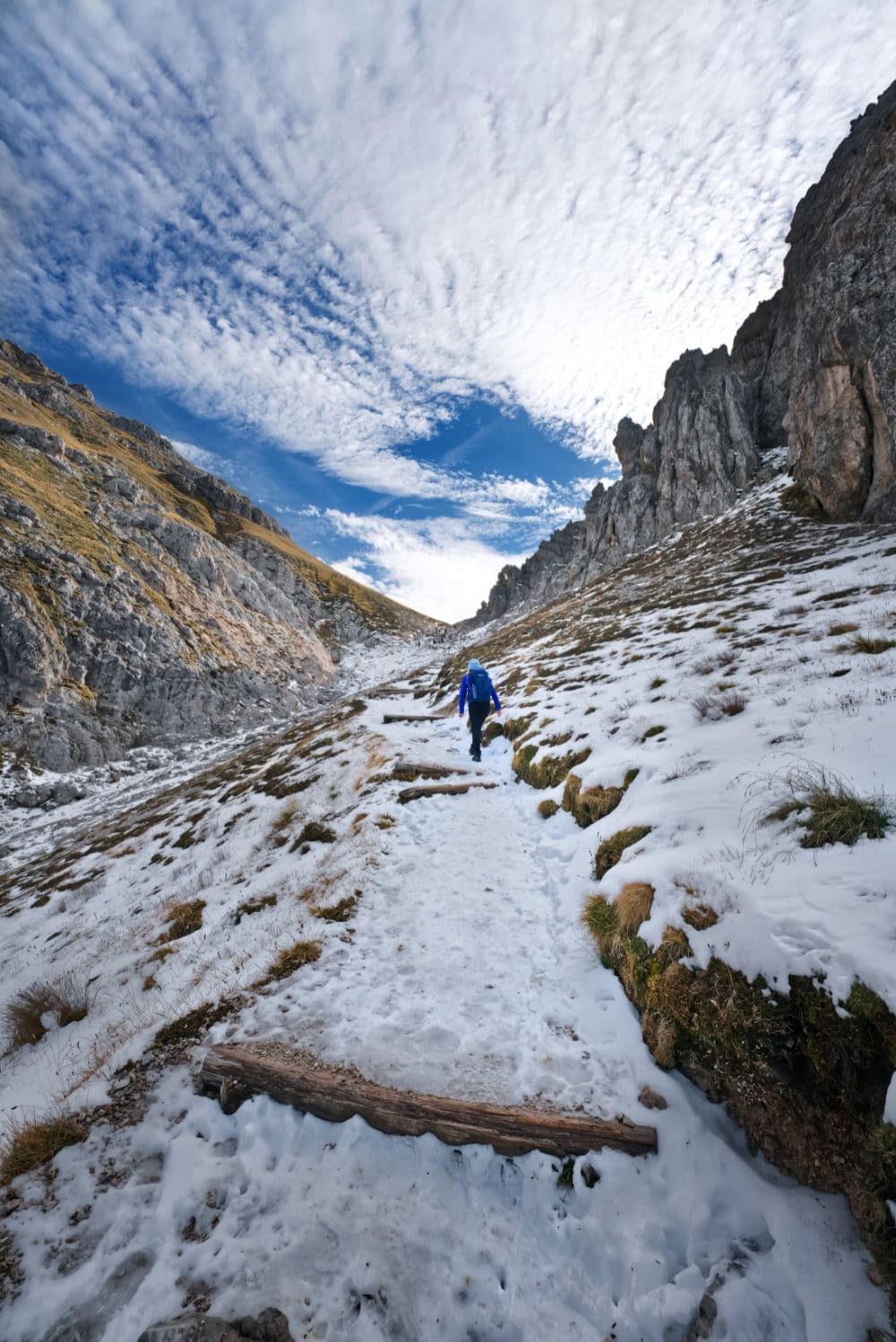
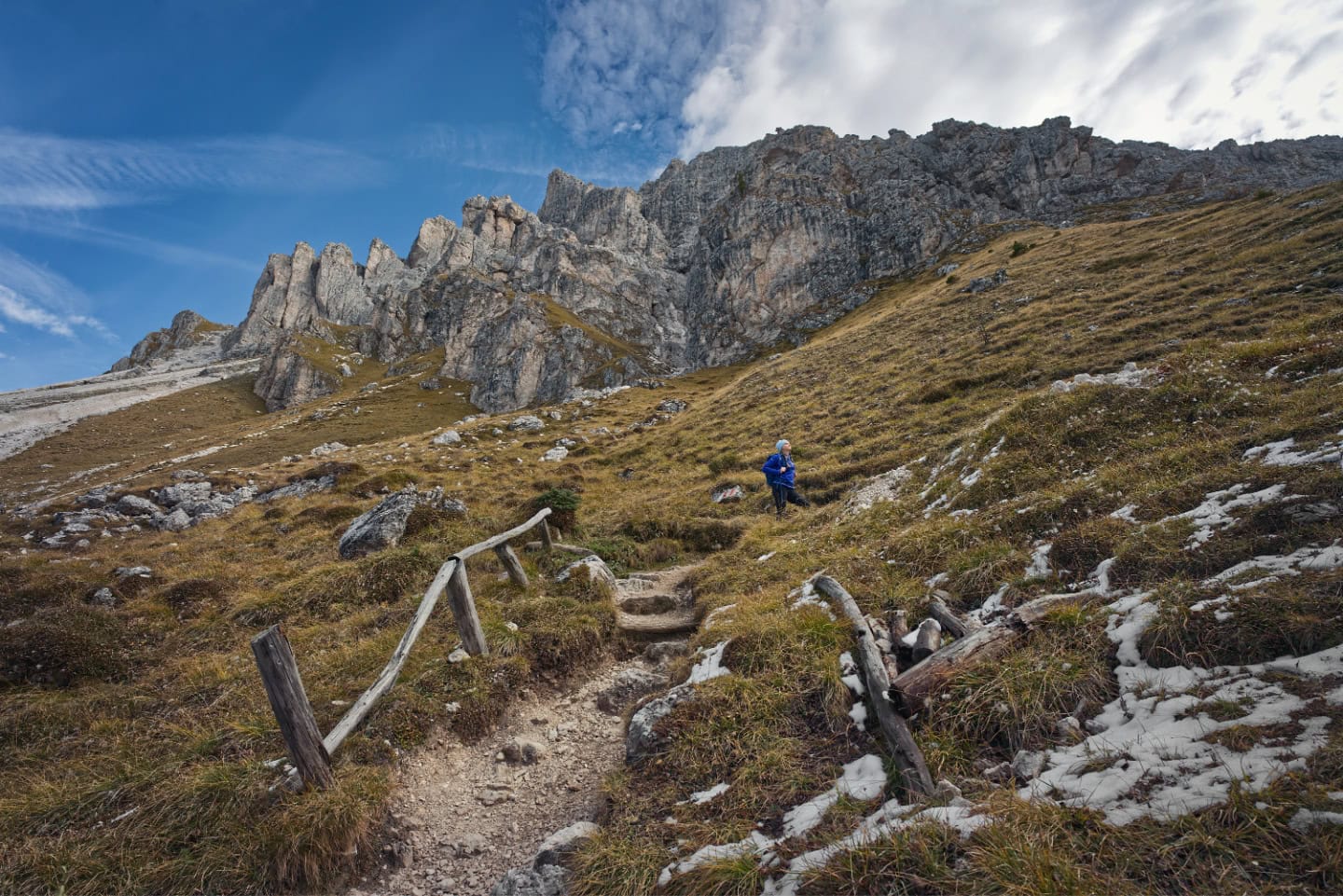
The next segment is the most challenging of the hike. After the gradual climb, trail no. 8A intersects with trail no. 4, also sign posted as Alta Via 2. Follow trail no. 4 to the left and prepare for a sustained upward zigzag through a gully that’s strewn with boulders and a trickling stream.
The hike up to the Furcela de Pütia is steep enough to raise your heart rate and make you earn whatever you order at the huts ahead. While demanding, it never tips into demoralizing. Be sure to follow the red painted waypoint dots on the boulders for the best way to the saddle.
When you arrive at Forcela de Pütia it’s a delightful surprise. Here, you’re standing at a height of 7,752 feet (2,362 m) and are confronted with rolling pastureland that unfurls towards the Fanes-Senes-Braies group. We recommend resting here for a bit on one the saddle’s benches before continuing onto the third segment of the Peitlerkofel circuit.
Segment 3: Through the Peitlerwiesen Meadows
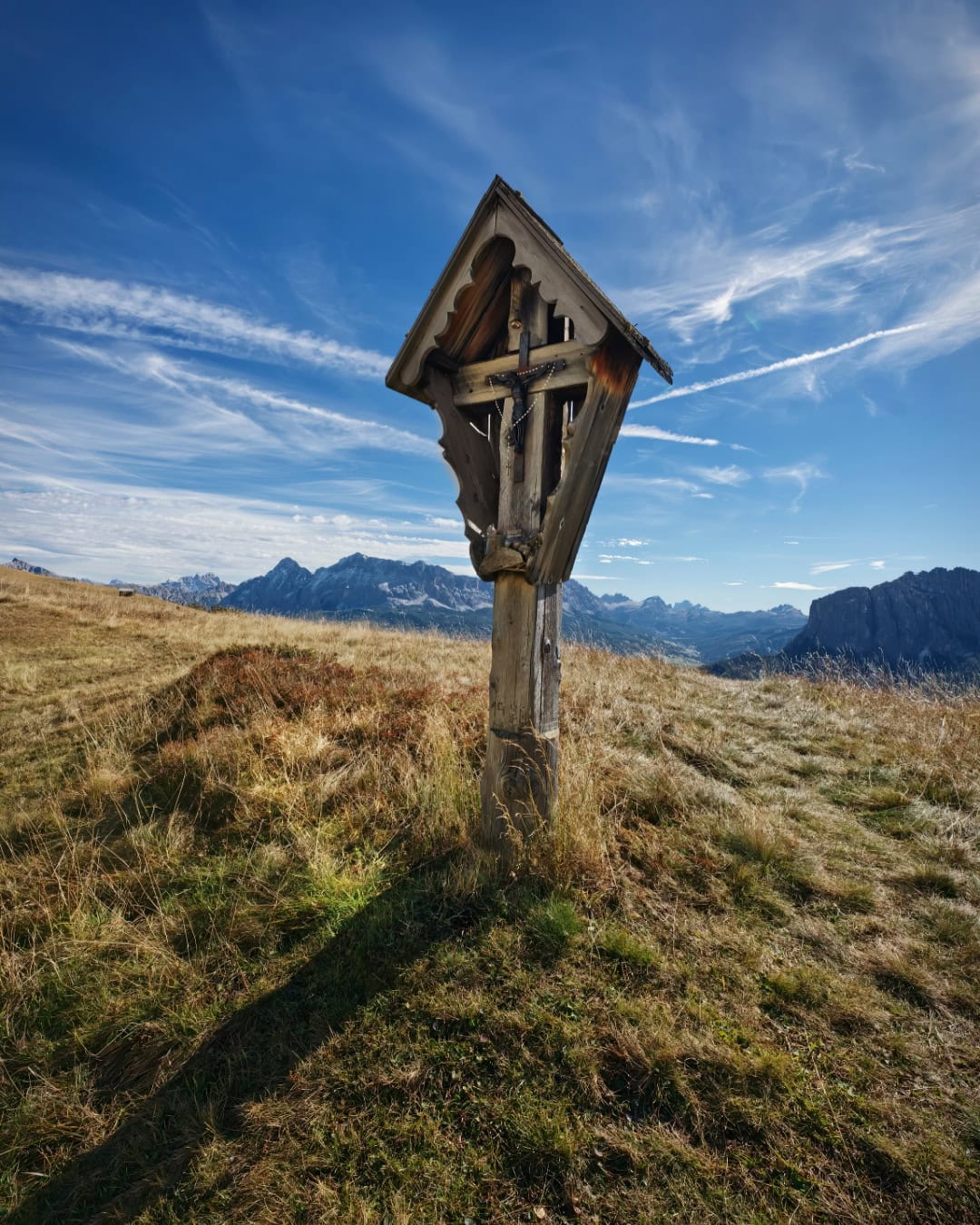
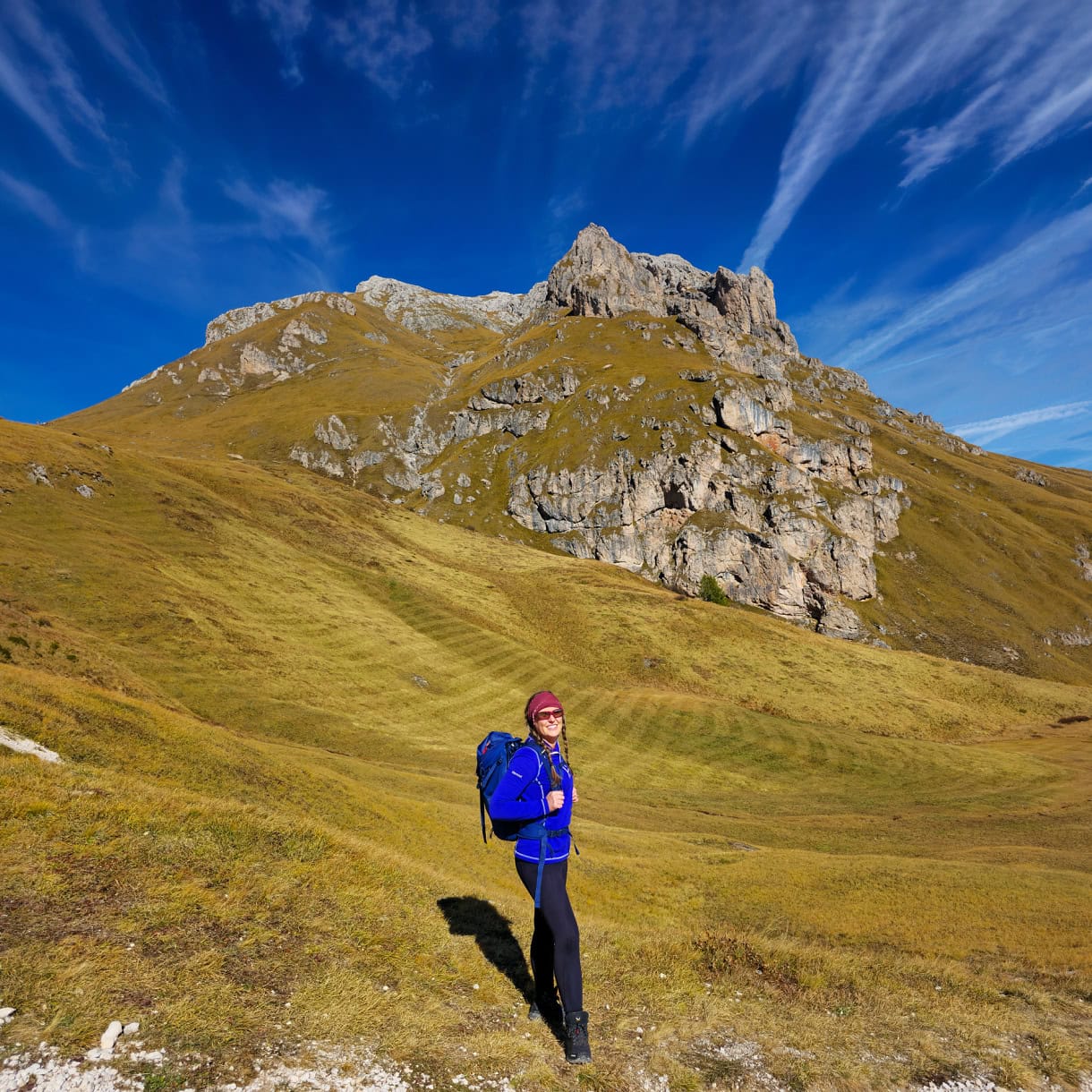
When you’re ready to move on from the saddle, you’ll notice the trail forks three ways: left to the Peitlerkofel summit, middle on trail no. 4B, and to the right to Schlüterhütte (Rifugio Genova), a mountain hut with overnight options that is about a 30-minute trek. To continue the circuit, take 4B.
📌 Good to Know: The summit is a separate ambition, not a casual add-on to the circuit. If you would like to tackle it, bring a climbing helmet at minimum. A full via ferrata kit is advisable for anyone less comfortable with height.
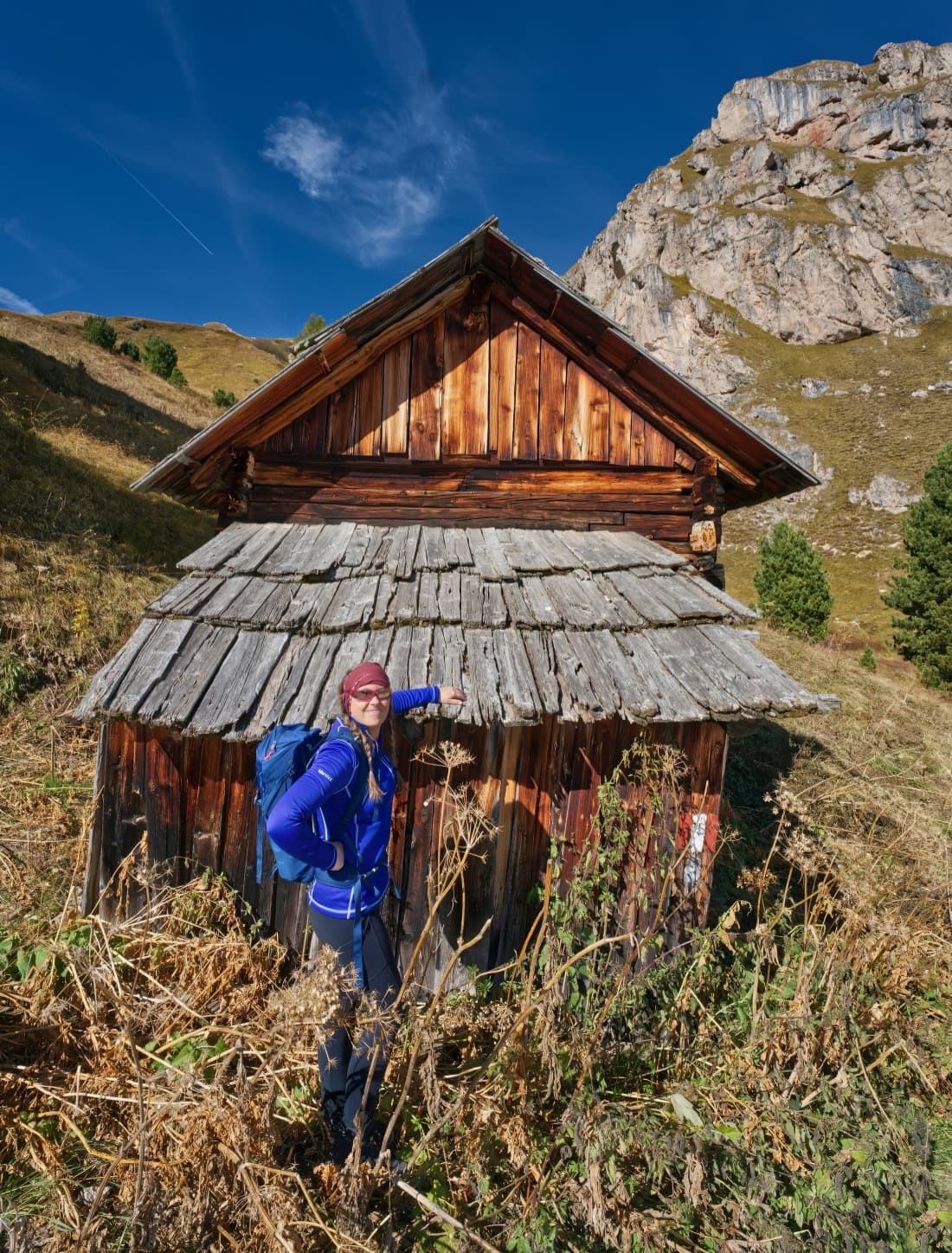
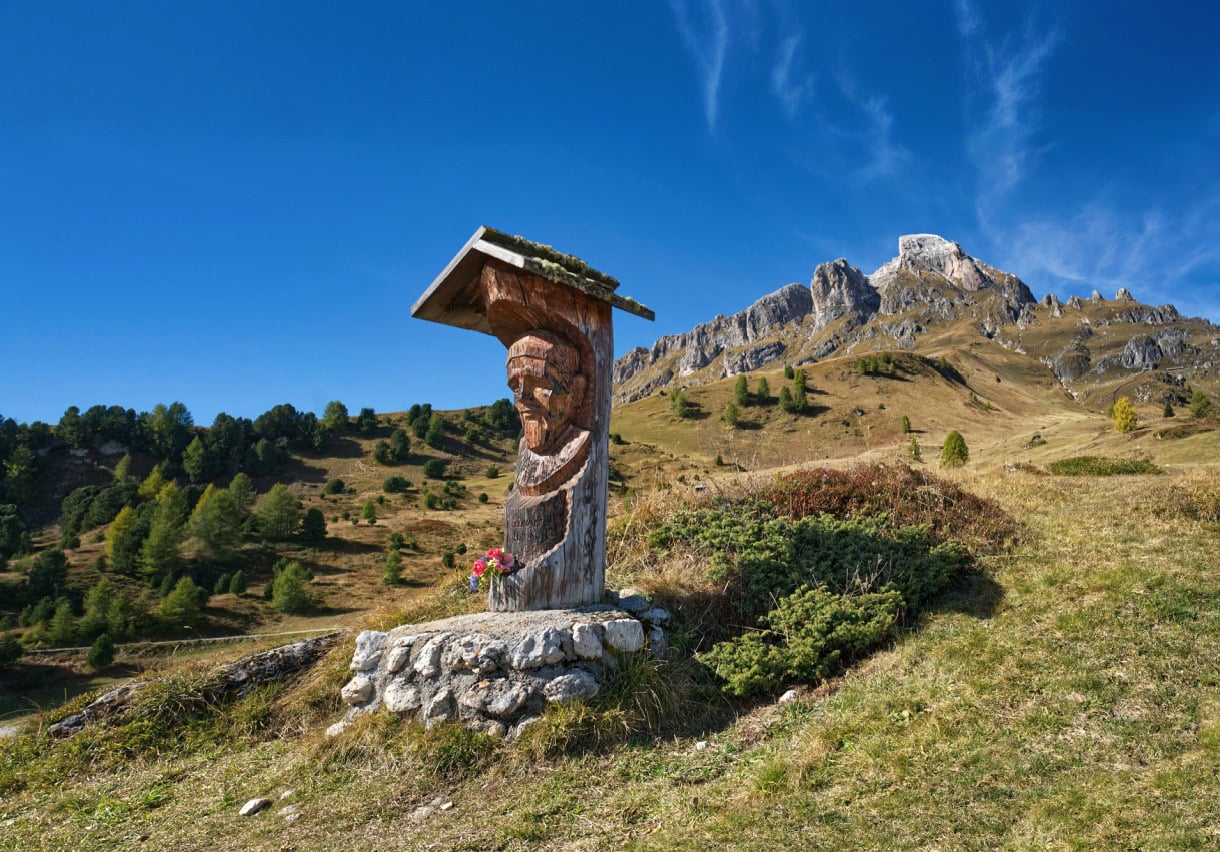
As you head downhill, the terrain changes at once. The stone-walled severity of the gully gives way to sloping pastures, hay huts, and wide-opening views in every direction. This pastoral postcard is known as the Peitlerwiesen (Prà de Pütia) meadows. Here, you’ll pass several beautiful wayside shrines, along with a remarkable wood-carved monument to St. Joseph Freinademetz, the first saint of South Tyrol.
Born in Val Badia, he is still deeply honored throughout the region. You will find his image in churches throughout the Ladin valleys of South Tyrol. A gifted linguist who spoke seven languages, he went on to serve as a missionary in China during a time of Christian persecution.
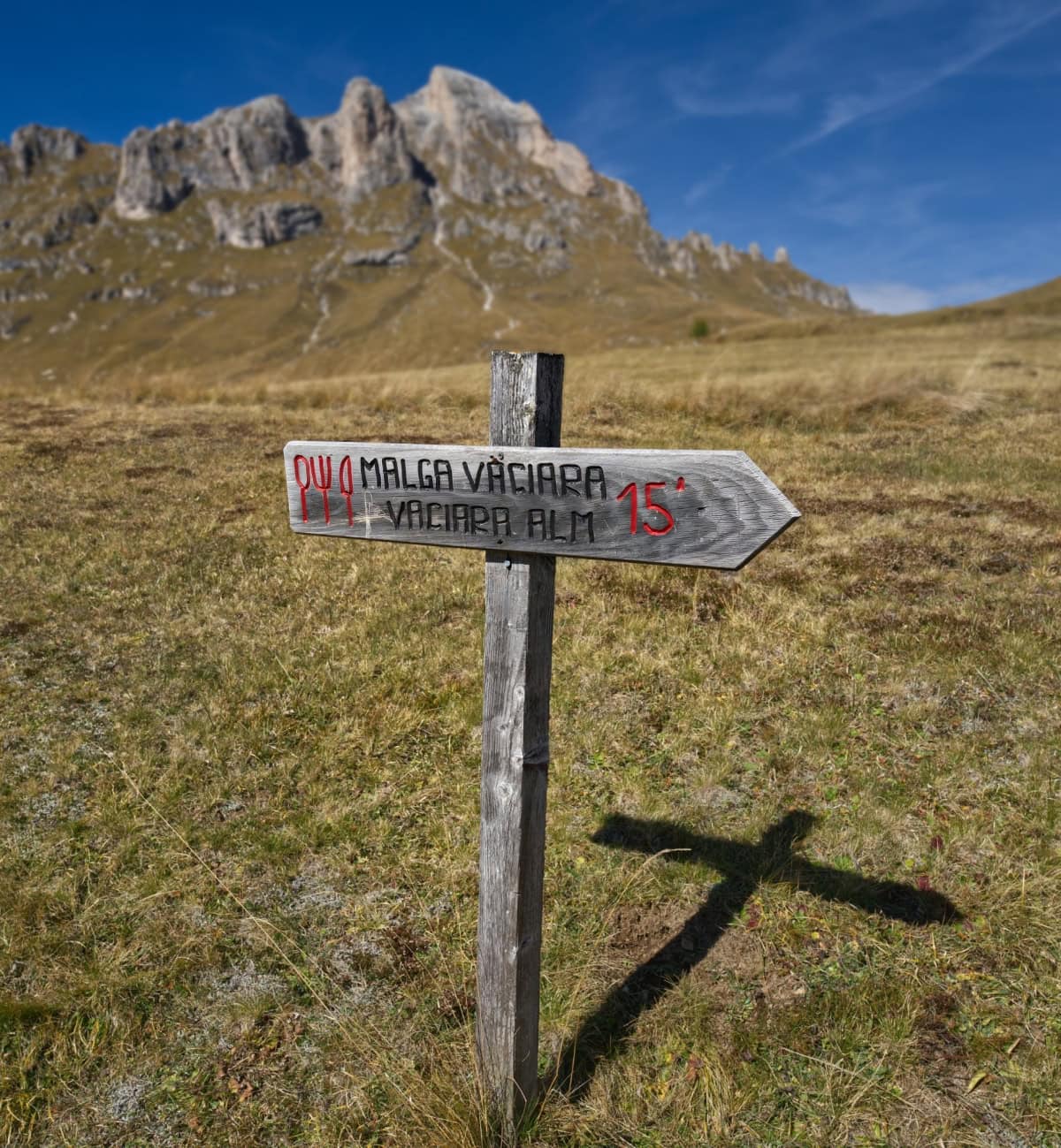

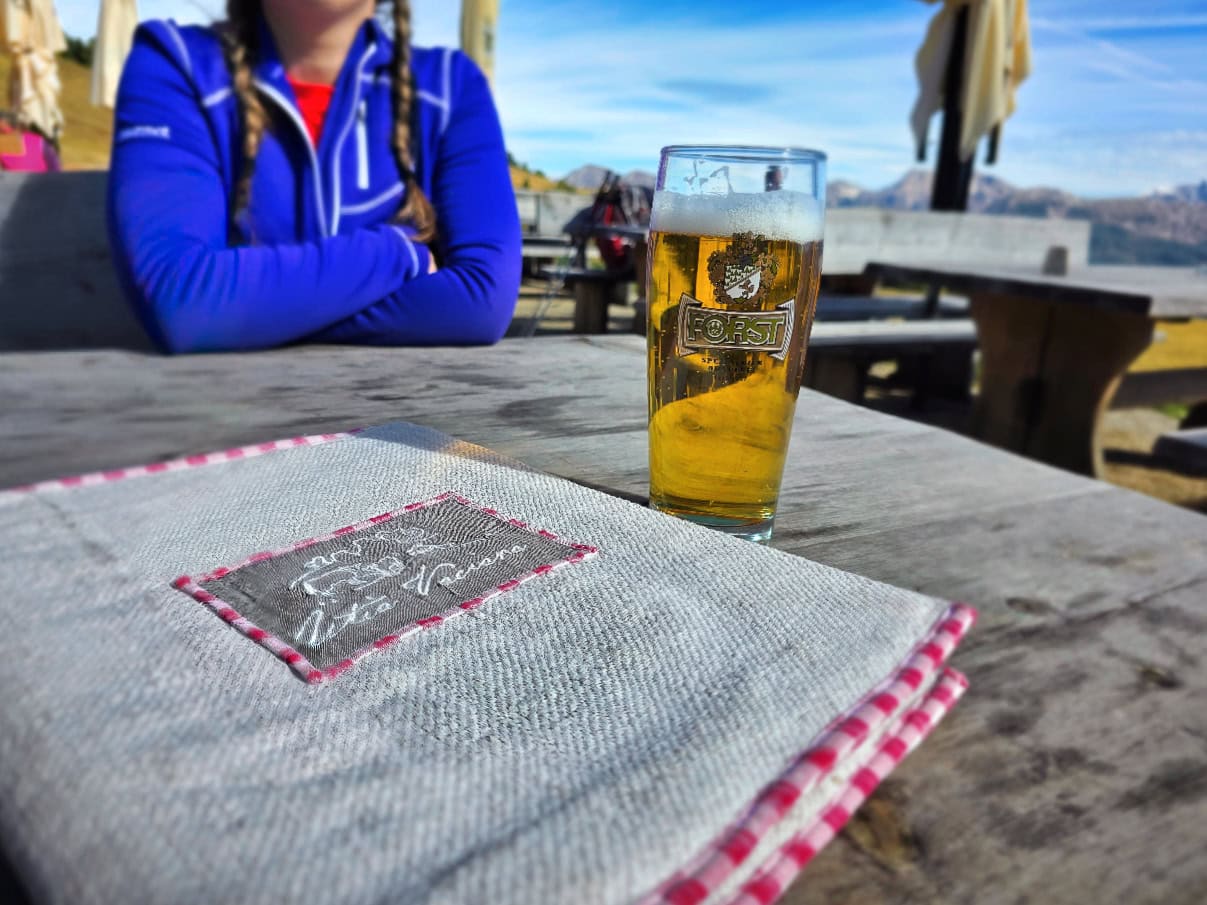
Trail no. 4B runs into trail no. 35, which follows a wide, gentle track to Ütia Vaciara, a family mountain hut sitting directly on the circuit. It offers a chance to grab a meal and drink while enjoying a panorama of Sass dla Crusc, a sacred massif long venerated by the Ladin people. After the saddle climb, we didn’t pass up a chance to fuel up here.
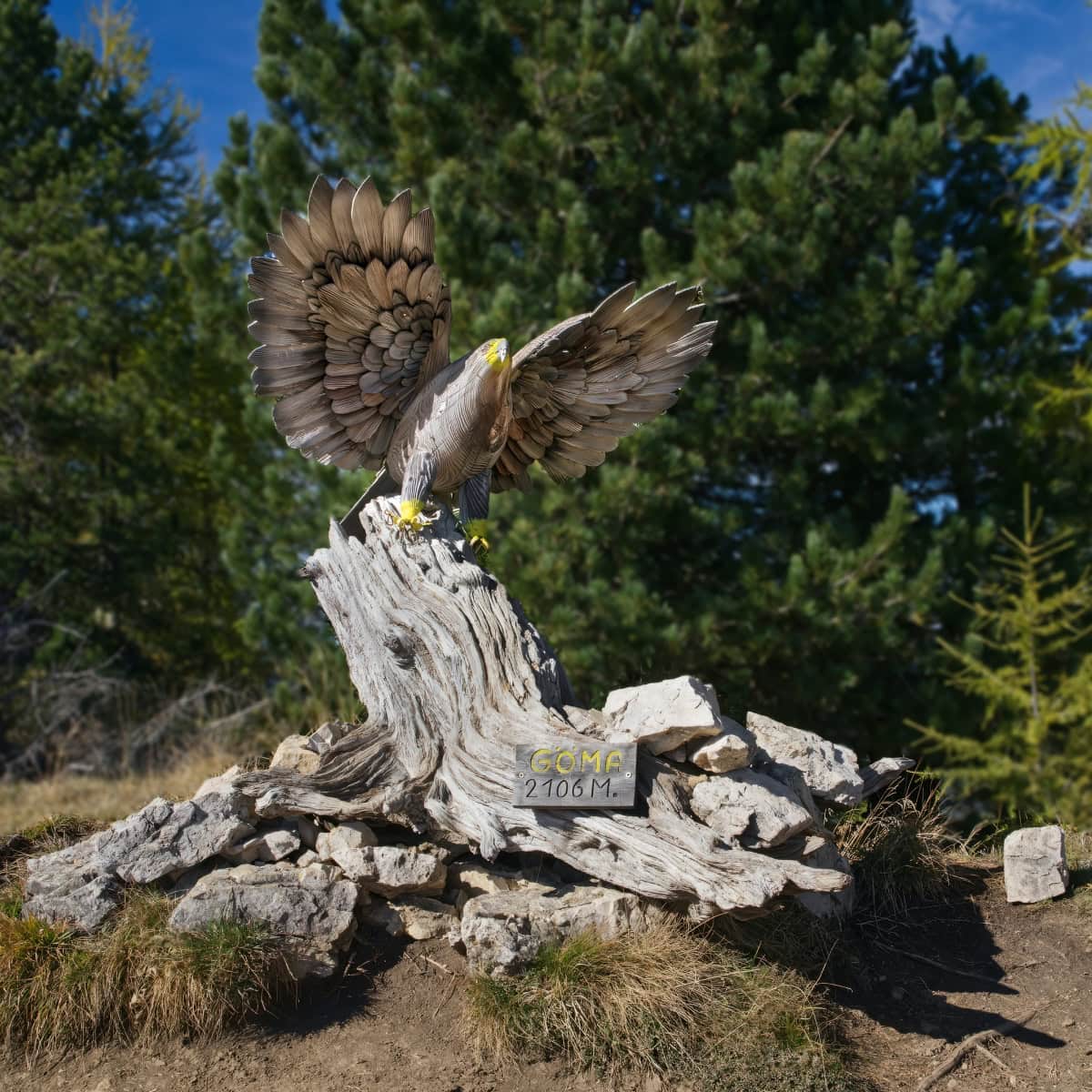
Beyond Ütia Vaciara, continue on trail no. 35 toward Göma Pass, a gentle saddle at the far end of Peitlerkofel’s southern face, where the circuit begins bending back toward the mountain’s northern flank. The pass is a lovely place to pause, take in the views, and admire the striking wood carving of a golden eagle in flight.
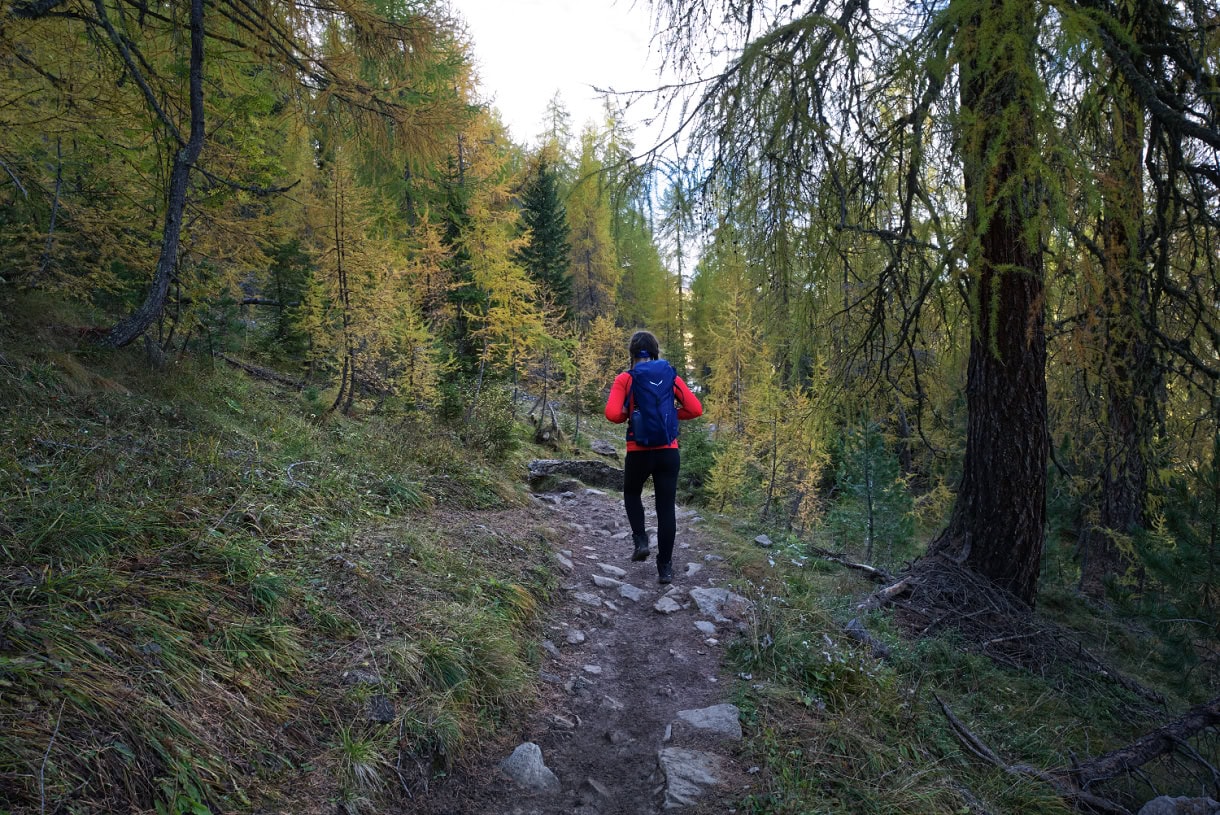
When you are ready to move on from Göma Pass, descend on trail no. 8B toward Ütia de Göma. As the trail winds through an ancient larch forest, the Zillertal Alps hold the northern horizon. This chain of peaks sits on the border with Austria, and its distant, glaciated bulk gives this stretch an entirely different character from the pastures and limestone drama surrounding Peitlerkofel.

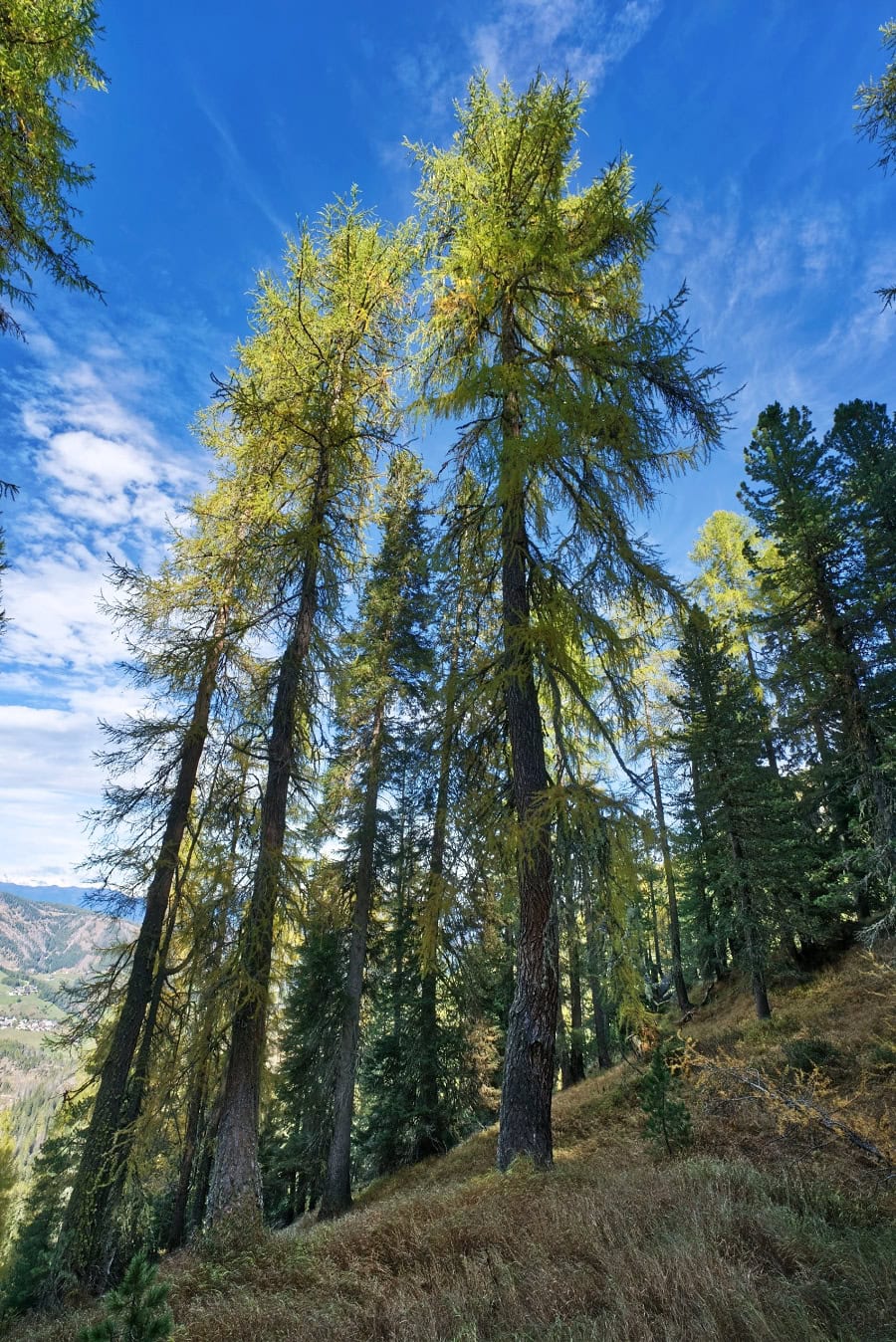
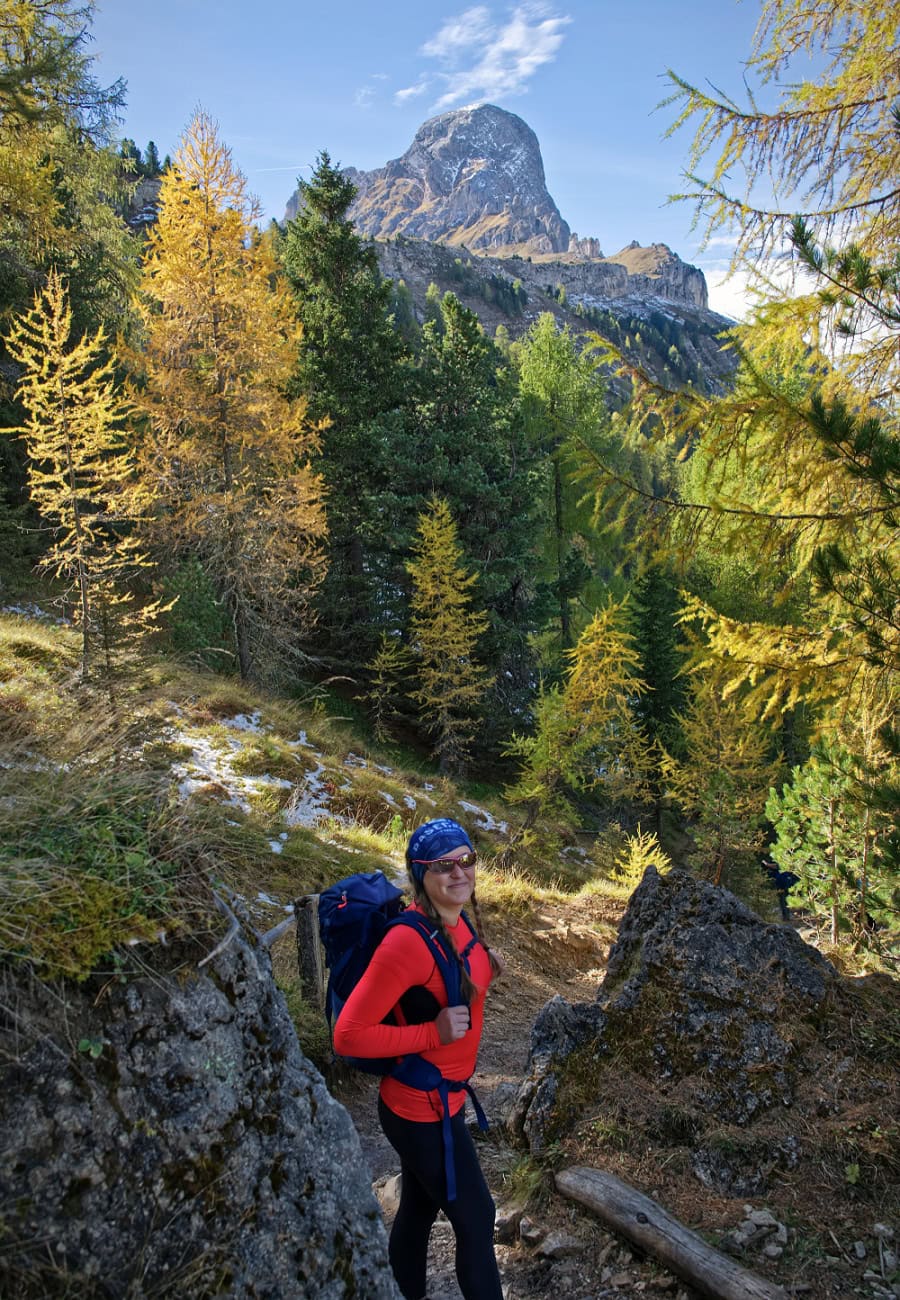

Looking toward Peitlerkofel, you can now make out the nose of the “locomotive,” the blunt front that makes the massif seem as though it is barreling forward. From this angle, the comparison feels even more apt.
Eventually the forest opens onto a broad meadow where Ütia de Göma appears like a small alpine sanctuary. It is an ideal place to justify dessert after lunch at Ütia Vaciara. We settled into a table and made short work of a plate of Kaiserschmarrn before tackling the final stretch.
Segment 4: The Bewitching Return
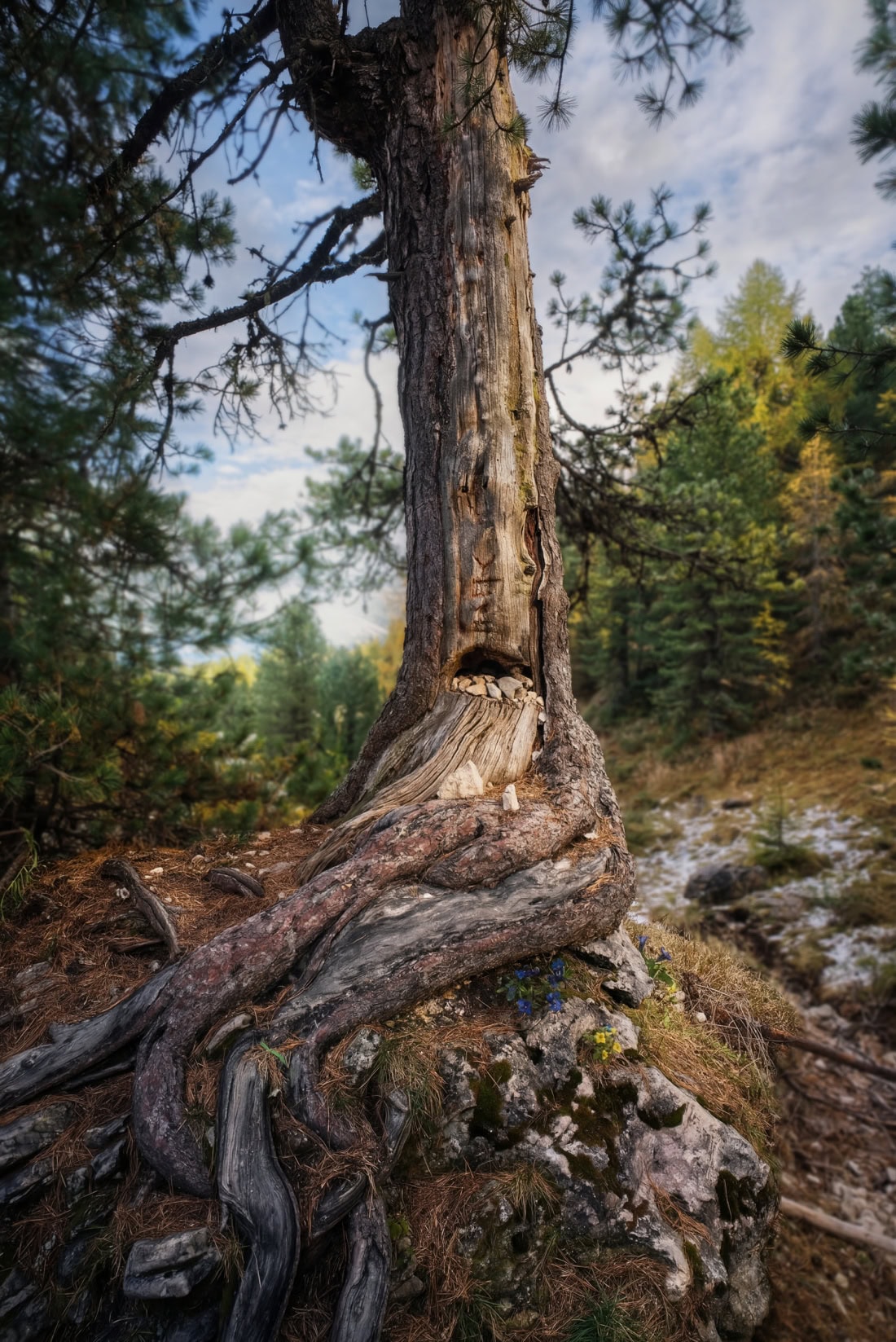
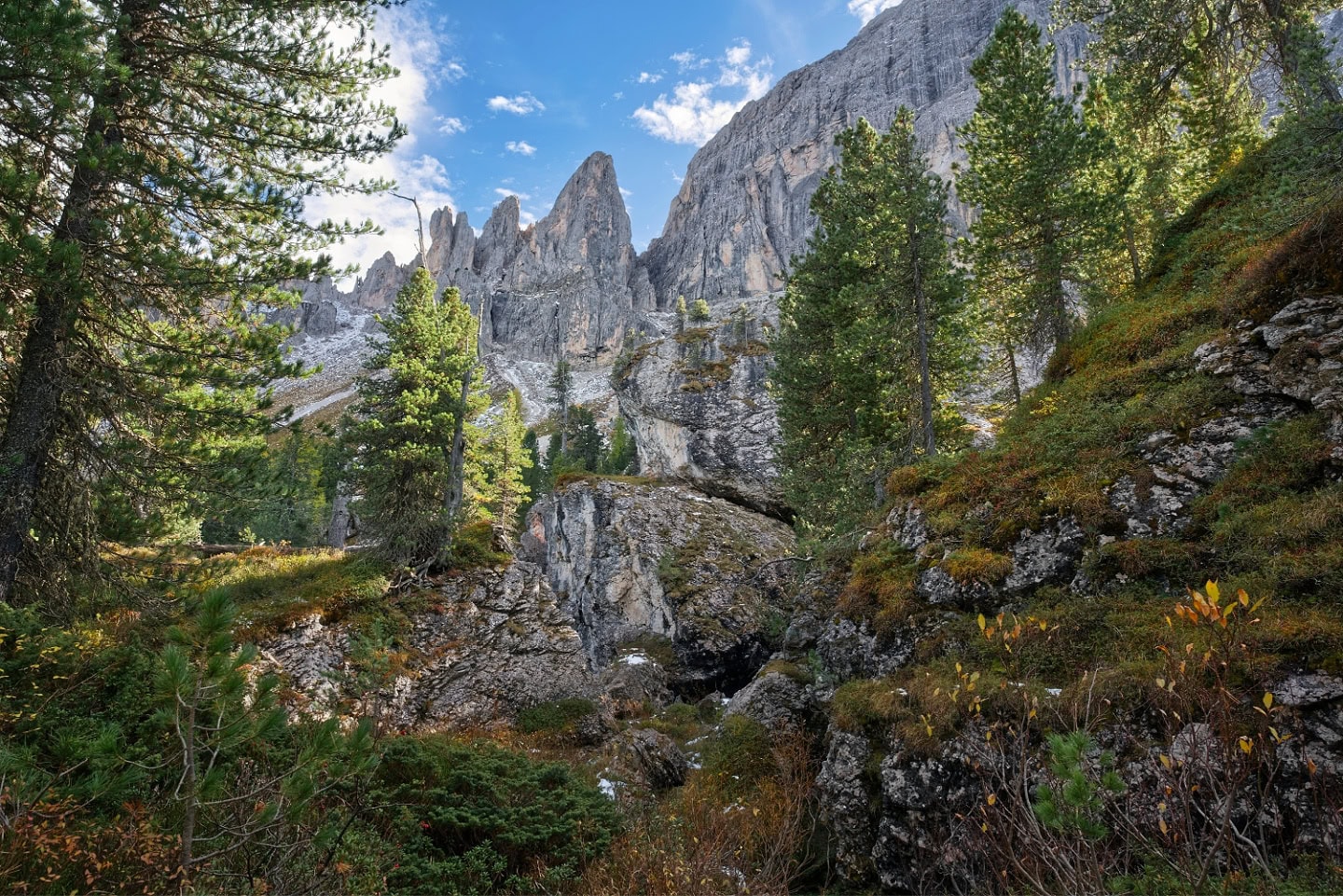
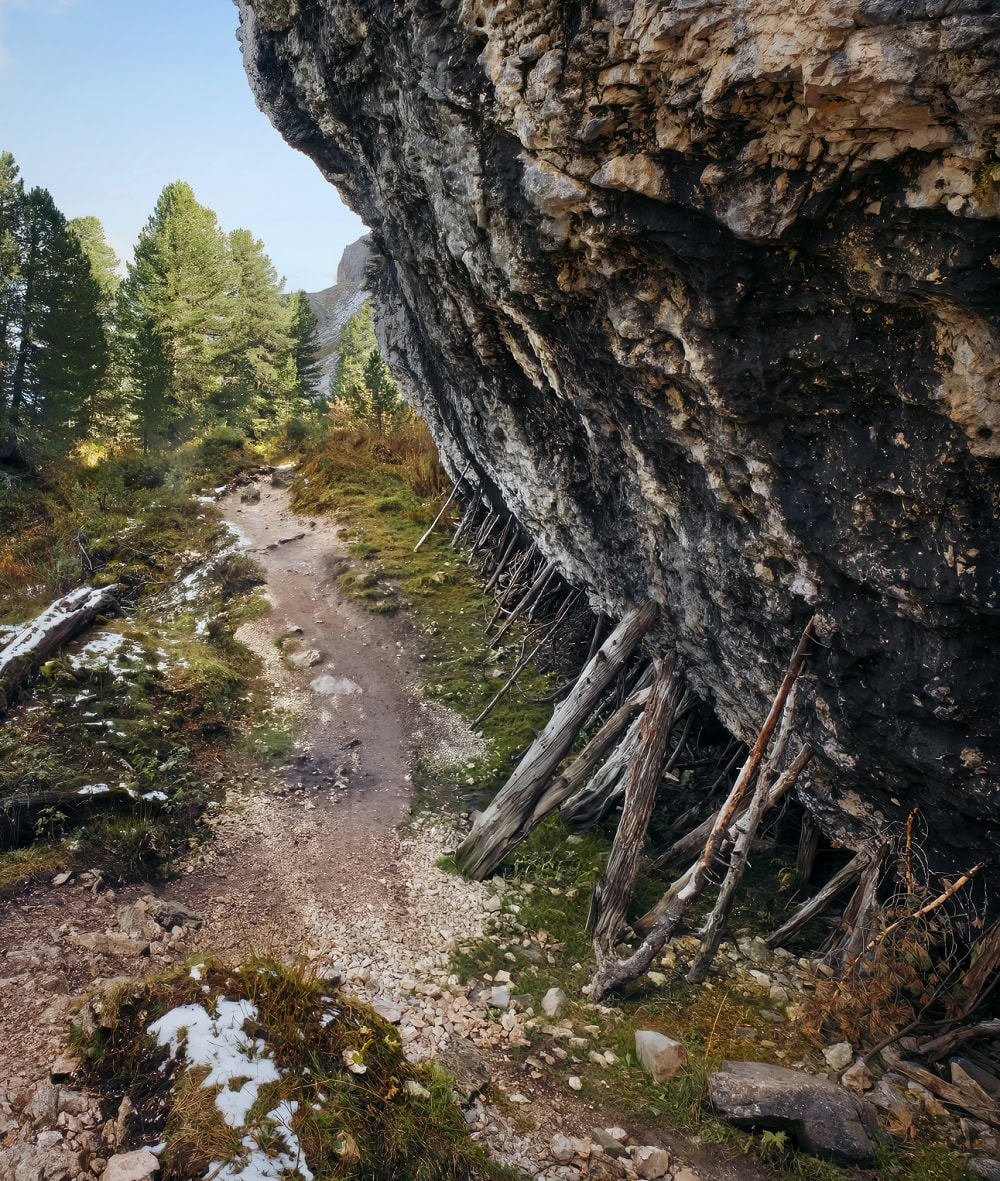

After visiting Ütia de Göma, continue on trail no. 8B through larch forest and into the so-called Hexenschlucht, or Witches’ Gorge, where the trail narrows and the mood turns cooler, darker, and more enclosed. This leg of the hike is riddled with massive boulders, shadowed crevices and twisted trunks that look like souls seized mid-motion. Walking through this corner of Peitlerkofel makes it easy to see why the mountain fed local superstition.
In the folklore around Passo delle Erbe and Peitlerkofel, witches were said to gather here on full-moon nights, stir up violent mountain storms, and lure wanderers toward danger. Those stories still echo in the annual Bal dles Stries, or Witches’ Dance, held at Passo delle Erbe each summer.
Beyond the gorge, the path climbs steadily to the Munt de Fornella alpine pasture, the same junction where the loop began, now approached from the other side. This is a fine place to linger over a meal or a drink at Munt de Fornella, a gorgeous hut with one of the best positions on the entire circuit. Spend enough time here and you may find yourself plotting how to smuggle one of the friendly goats back home.
From the hut, turn right onto the familiar trail no. 8A and follow it back toward Passo delle Erbe. Along the way, you will return to that same yawning viewpoint, where the mountain’s northern face reveals itself once more, now washed in the golden light of late afternoon. Peitlerkofel looks older, stranger, and even more self-possessed than it did before. A proper final image to carry down the mountain.
Where to Stay to Hike Peitlerkofel / Sass de Putia
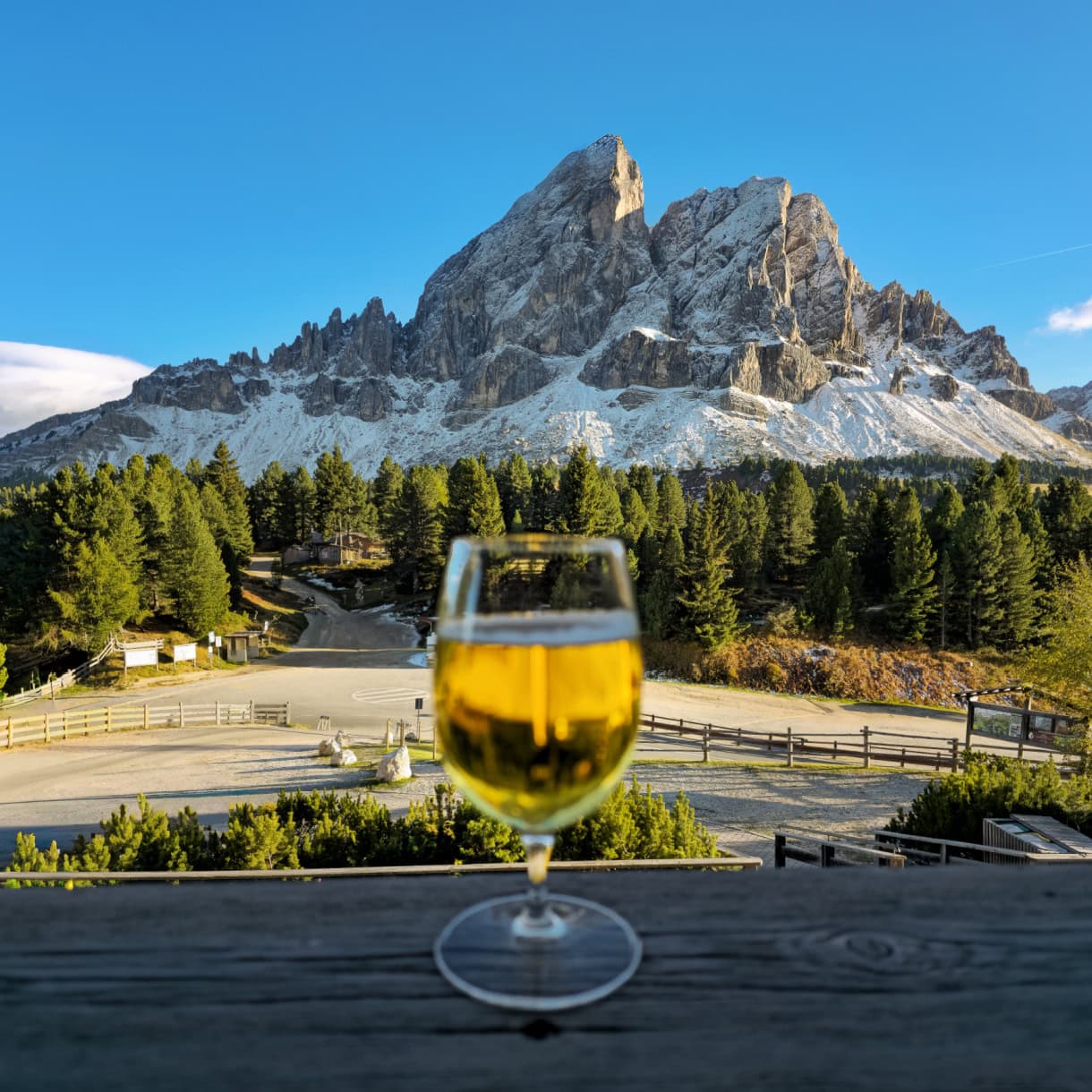
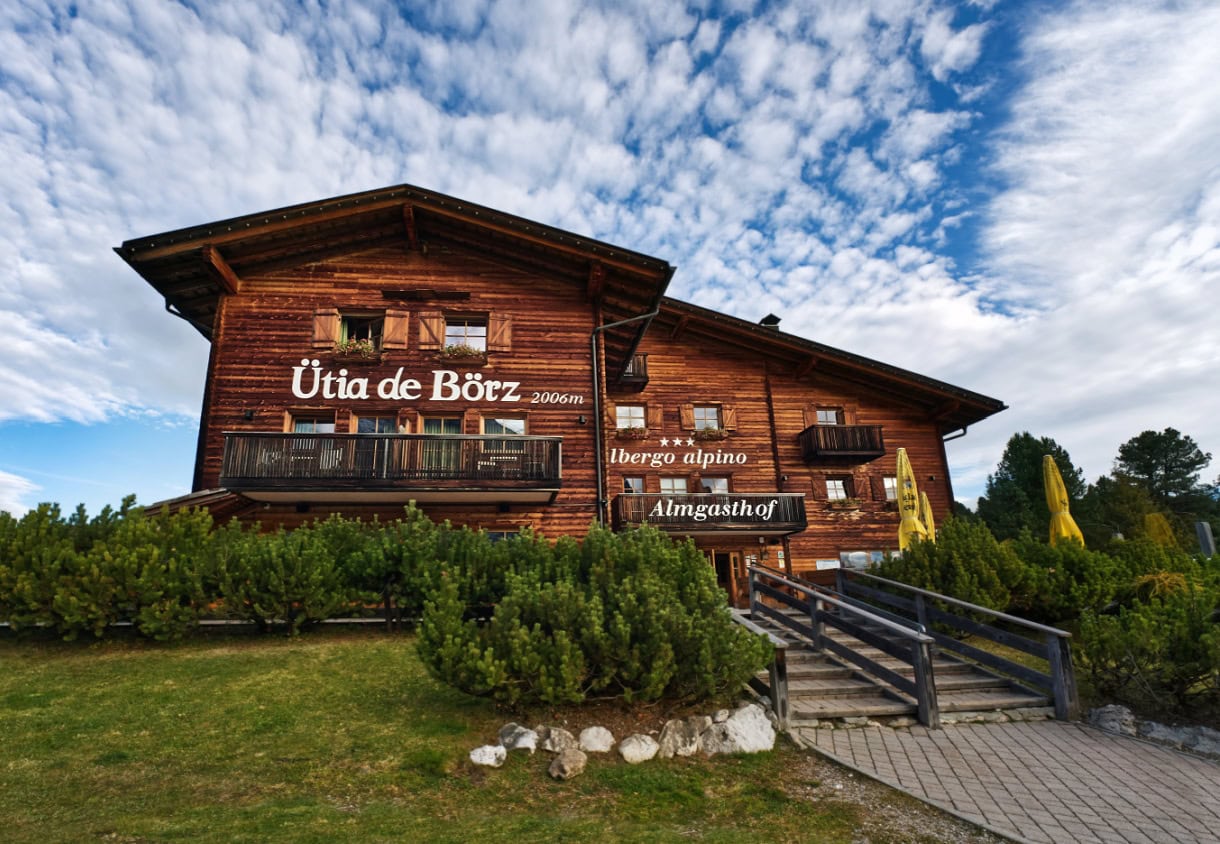
If you want the easiest possible access to the Peitlerkofel Circuit, stay at Ütia de Börz. It sits right at Passo delle Erbe, which means you can start early, avoid the stress of the drive, and experience sunrise or sunset at the pass without playing roulette on a mountain road in the dark.
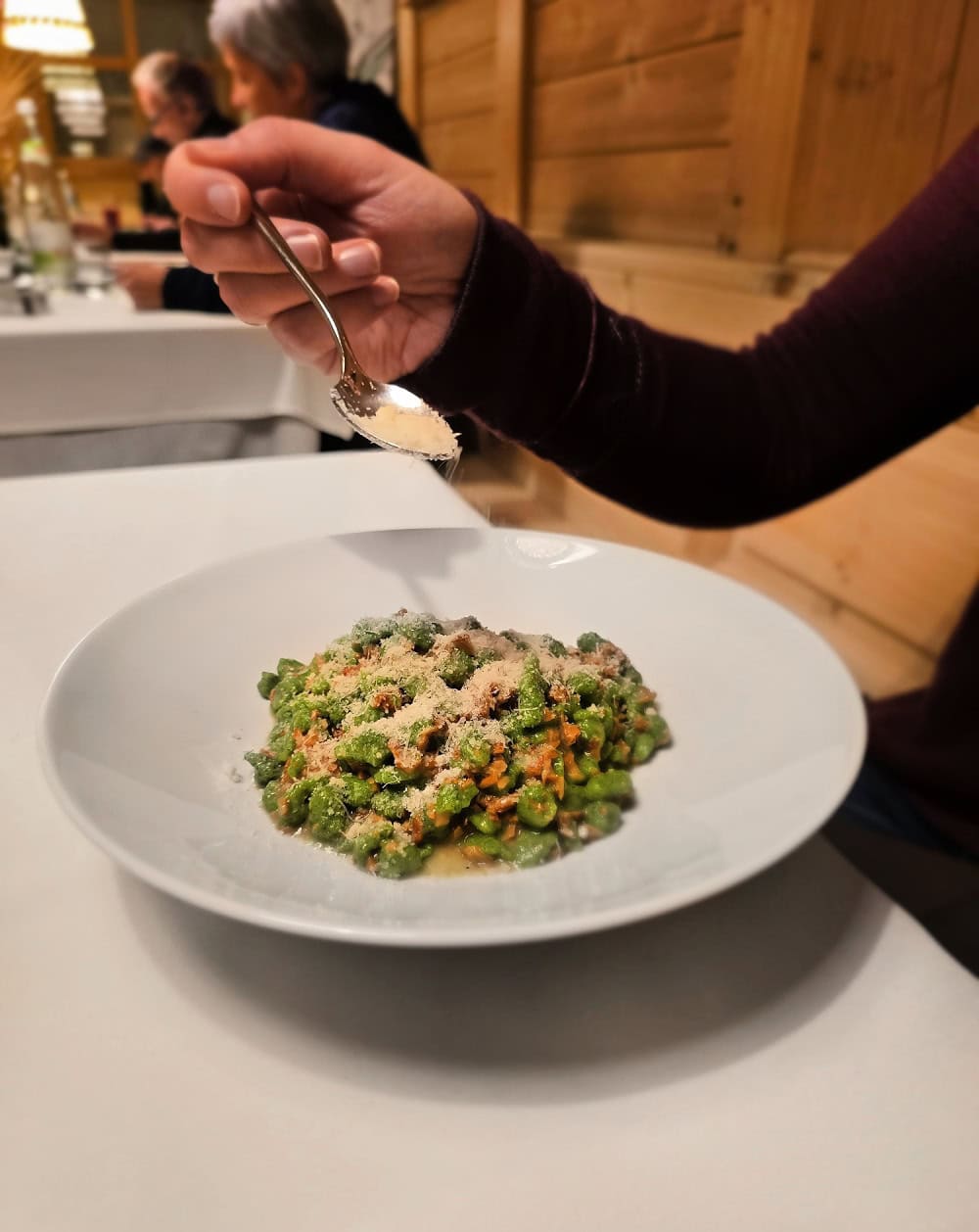
Our stay at Ütia de Börz was wonderful from start to finish, and the staff could not have been more helpful or welcoming. The food was fantastic, the atmosphere wonderfully cozy without a hint of mountain kitsch, and the whole place had an easy warmth that made us feel right at home.
Another option that sits within easy driving distance of Peitlerkofel is Chalet Frapes. This family-owned farm is near the village of Antermoia on the road connecting Val Badia with Eisacktal, giving you relatively convenient access to iconic destinations such as Lago di Braies and Prato Piazza.
Best area for LONGER STAY: Val di Funes
If you want to pair this hike with several days in one of South Tyrol’s most visually memorable valleys, Val di Funes is a strong base.
Good options to consider:
- Lippmöshof – A lovely farm stay with tremendous valley and mountain views
- Hotel Ranuimüllerhof – A warm, traditional stay near the St. Johann chapel
- Hotel Fines – A great village stay option in Santa Maddalena